


Oakville · Virtual in Ontario & select provinces
Couples Therapy
You love each other. So why does it feel this hard?
- Free 15-minute consultation
- Receipts for extended health benefits
- In person in Oakville, serving Burlington & Milton, or virtual in Ontario & select provinces





4 therapists, one teamOakville & online in Ontario & select provinces
Not Sure Who to See?
Tell us a little about what’s going on and we’ll suggest the therapist who fits.
We’ll match you →Maybe it started with the dishes. Or the tone. Or the look. Or the fact that one of you said “I’m fine” in a way that was very clearly not fine. And somehow, twenty minutes later, you’re not talking about the dishes anymore. You’re talking about everything. Who does more. Who cares more. Who always gets defensive. Who never listens.
Maybe you keep having the same argument with slightly different details. Maybe you don’t fight at all anymore, and honestly, that feels worse. You’re polite. You’re busy. You’re co-managing a household like two very tired coworkers. But you can’t remember the last time you felt really close. Or maybe something happened. An affair.
A betrayal. A baby. A move. A loss. We provide couples therapy in Oakville and online across Ontario and select provinces and territories for couples who want to communicate better, break out of painful conflict cycles, reconnect emotionally, rebuild trust, navigate big life changes or get clearer about the future of their relationship. You don’t have to be on the brink of breaking up.
And you don’t have to agree on exactly what the problem is before you come in. Most couples don’t.
What Is Couples Therapy?
Couples therapy is psychotherapy where partners attend sessions together to work on their relationship. Instead of one person telling their side of the story to a therapist, you’re both in the room. That means the focus isn’t only on what each of you thinks, feels, and needs. It’s also on what happens between you. The things that get said, the things that don’t get said, and the things that get said very loudly at 11:30 p.m.
Couples therapy isn’t about deciding who’s right. The relationship is usually the client. Your therapist’s job is to help you both understand the cycle you keep getting caught in, make room for what each of you is feeling underneath it, and practise new ways of responding to each other.
What Can Relationship Struggles Look Like?
Every relationship goes through hard seasons. But sometimes a hard season starts to feel like a permanent climate.
You might notice:
- Having the same argument over and over
- Arguments escalating quickly
- One partner wanting to talk while the other shuts down
- Feeling criticized, dismissed, or ignored
- Walking on eggshells
- Avoiding certain topics entirely
- Feeling more like roommates than partners
- Less affection, physical touch, or sex
- Mismatched desire
- Feeling lonely in the relationship
- Difficulty trusting each other
- Struggling after infidelity or betrayal
- Constant tension about chores, money, parenting or in-laws
- Keeping score
- Resentment that never quite goes away
- Difficulty repairing after a fight
- Saying sorry without anything actually changing
- Stress from work, kids, or family spilling into the relationship
- Feeling like you’ve grown apart
- Disagreeing about big decisions, like marriage, kids, moving or money
- Struggling to adjust to a major life change
- Wondering whether you should stay together
Sometimes couples know exactly what they’re fighting about.
And sometimes you’re sitting in a session saying:
“Honestly, we don’t even know how it got this bad.” That’s okay. We can start there.
Communication: “We Just Don’t Communicate Well”
This is one of the most common things couples say when they come to therapy. And sometimes it’s true. But often the problem isn’t that you don’t know how to talk. You both talk to other people just fine. You can handle difficult conversations at work. So why does one comment from your partner send you from zero to furious in four seconds?
Because when we feel hurt, dismissed, or disconnected from the person who matters most to us, it’s hard to stay calm and thoughtful. You feel criticized and immediately defend yourself. You feel unheard and get louder. You feel overwhelmed and go quiet. You say the sharp thing because the vulnerable thing feels too risky. Couples therapy can help you slow those moments down so you can actually hear what your partner is trying to say, and say what you actually mean.
Not Sure Who to See? We’ll Match You.
Tell us a little about what’s going on and we’ll suggest the therapist who fits.
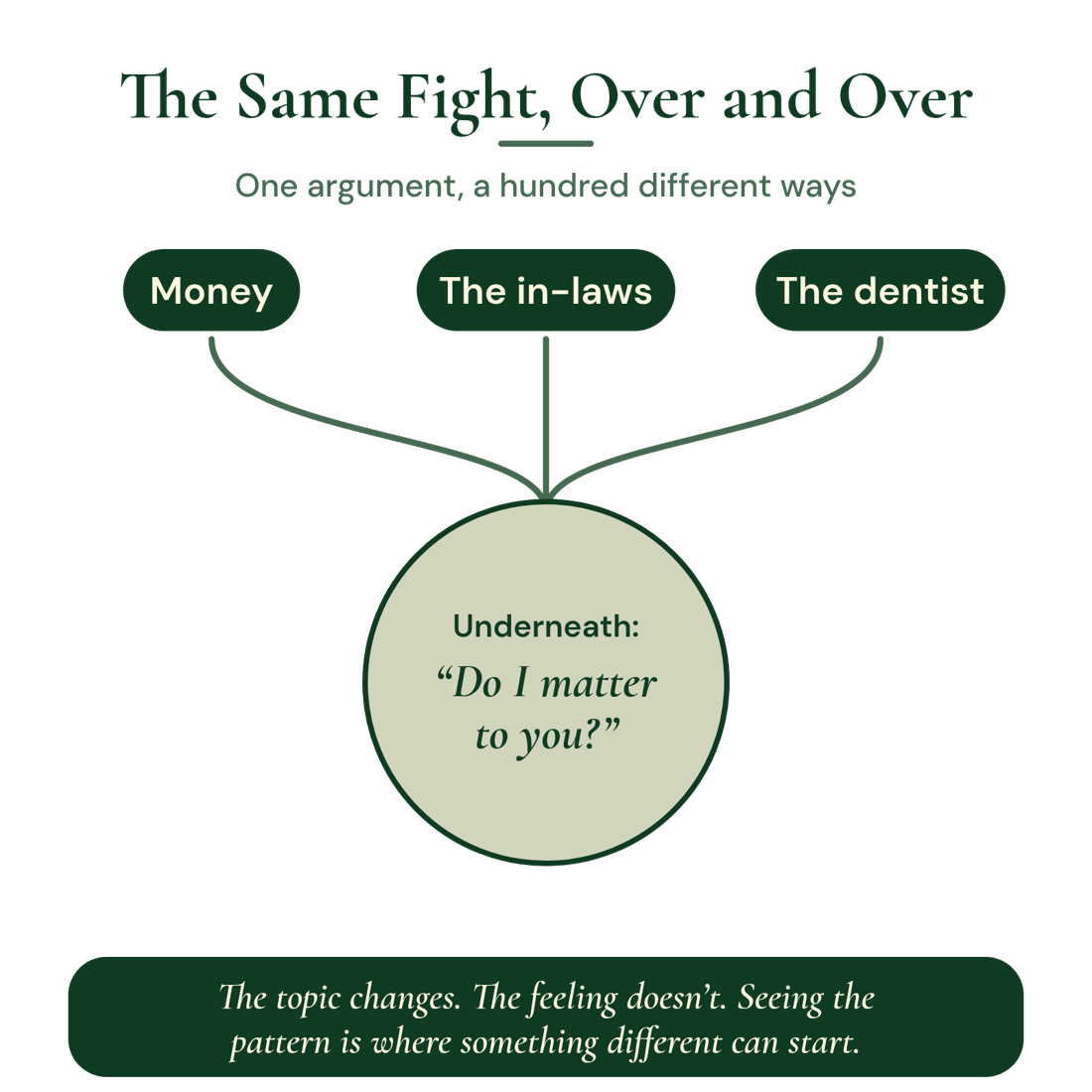
The Same Fight, Over and Over
Have you ever noticed that you’re not really having a hundred different arguments? You’re having one argument, a hundred different ways. It shows up about money. Then about the in-laws. Then about who forgot to book the dentist. The topic changes. The feeling doesn’t. “You don’t care.” “I can never do anything right.” “I’m always the one who has to bring things up.”
“Nothing I do is ever enough for you.” Couples often get stuck debating the details of what happened.
Meanwhile, the bigger question goes unanswered:
“Do I matter to you? Are you there for me?” Couples therapy can help you step back from the details and see the pattern you’re both caught in. Once you can see it, you can start doing something different with it.
Pursue-Withdraw Cycles
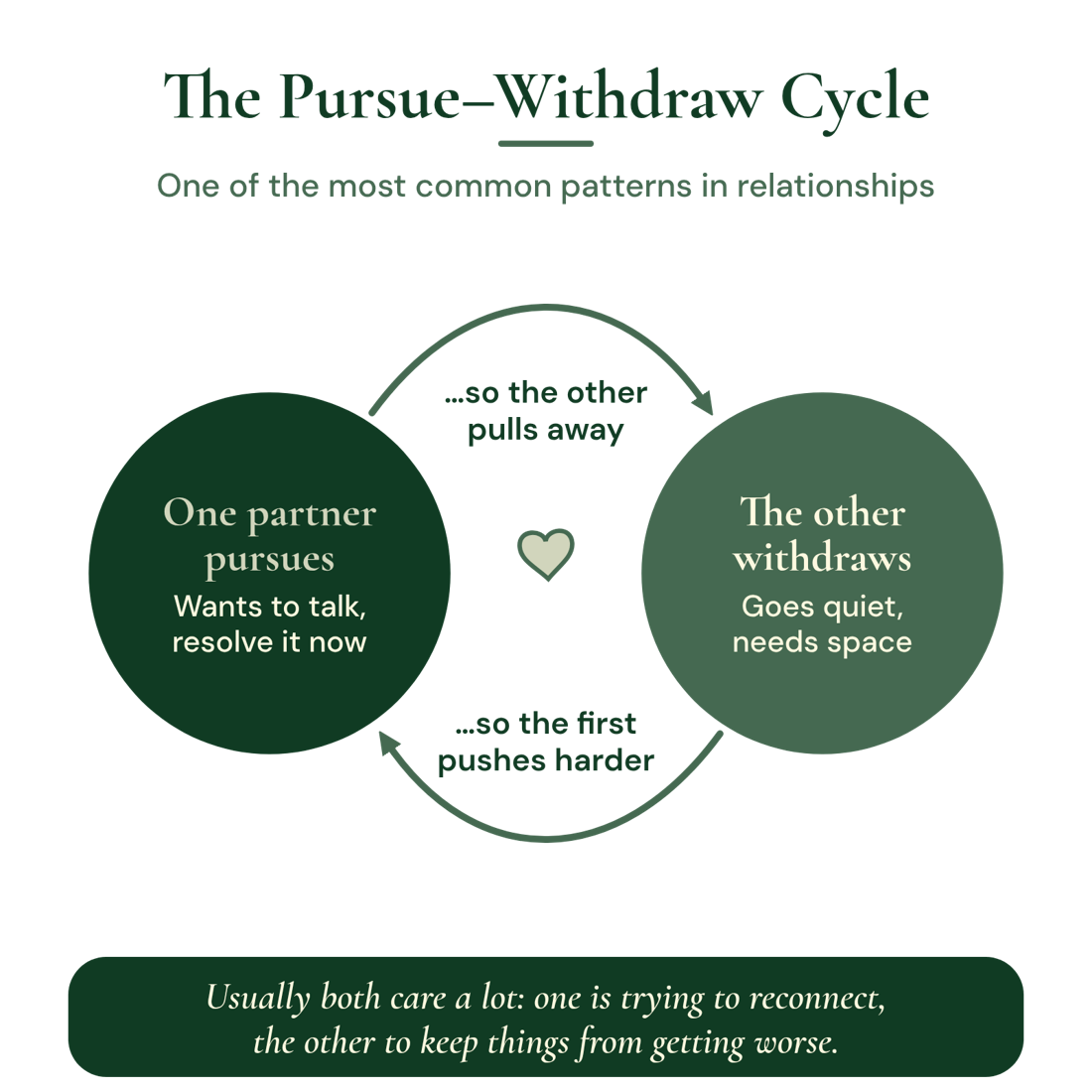
One of the most common patterns in relationships looks something like this:
One partner notices distance or tension and moves toward it. They want to talk. Resolve it. Figure it out. Right now, ideally. The other partner feels the pressure and moves away from it. They go quiet. Need space. Change the subject. Leave the room. Start doing something very important on their phone. The more one person pursues, the more the other withdraws.
The more one person withdraws, the more the other pursues. But usually both people care a lot. The pursuer is often trying to reconnect. The withdrawer is often trying to keep things from getting worse. And both of you end up feeling alone. Therapy can help you recognize the cycle as the problem, rather than each other. That shift alone can take a lot of heat out of the room.
Emotional Disconnection & Feeling Like Roommates
Not every struggling relationship is loud. Sometimes nothing dramatic is happening at all. You’re getting through the week. Work. Groceries. Bed. Repeat. You’re kind to each other, mostly. But you’re not really talking about anything that matters. You don’t feel known. You can’t remember the last time you laughed together, or the last time one of you reached for the other just because.
And when you do try to talk about it, it either turns into a fight or gets brushed off. Emotional distance can creep in slowly, especially during busy or stressful seasons. Couples therapy can help you understand how you drifted apart and what it might take to turn back toward each other.
Trust, Betrayal & Infidelity Recovery
Few things can shake a relationship like a betrayal. An affair. An emotional affair. Hidden finances. Lies about something big, or a lot of lies about things that seemed small. If you were the one who was hurt, you might feel like the ground disappeared. You may be replaying everything. Checking their phone. Asking the same questions again and again.
Swinging between rage, grief, numbness and desperately wanting things to go back to how they were. “How could you?” “What else don’t I know?” If you were the one who caused the hurt, you may be carrying shame, guilt, defensiveness or confusion about how you got here. You might want to fix it immediately and feel frustrated when your partner isn’t ready to move on.
Both experiences can be painful. Couples therapy can give you a structured space to talk about what happened, understand the hurt, and explore whether and how trust can be rebuilt. Rebuilding trust usually takes time. It can’t be rushed, and it can’t be done by one person alone. And sometimes, therapy helps couples realize they want to separate.
Either way, you don’t have to navigate the aftermath without support.
Intimacy, Sex & Physical Connection
Intimacy changes over the course of a relationship. That’s normal. But it can still be hard to talk about. Maybe one of you wants more physical closeness and the other wants less. Maybe sex has become infrequent, routine, or a source of tension. Maybe stress, a new baby, health changes, medications, menopause, body image or exhaustion have changed how you connect physically.
Or maybe you’ve simply stopped talking about it, and the silence has become its own thing. One partner may feel rejected. The other may feel pressured. Both may feel misunderstood. Couples therapy can help you talk about intimacy with more honesty and less blame, explore what’s getting in the way, and reconnect emotionally in ways that can make physical closeness feel more possible.
You don’t have to have the perfect words for this. Most people don’t.
Life Transitions: New Babies, Moving In & Blended Families
Big life changes can test even strong relationships. Moving in together. Getting engaged or married. Having a baby. Even changes you were both excited about can bring unexpected stress. When a new baby arrives, sleep disappears, roles shift and suddenly you’re having intense negotiations about who changed the last diaper. When you move in together, you discover your partner has very strong feelings about how to load a dishwasher.
When you blend families, you’re navigating new partners, children, ex-partners, co-parenting schedules, loyalty conflicts and different ideas about discipline, all at once.
You may be wondering:
“Why does this feel so hard when it’s what we wanted?” Because change asks a lot of a relationship. Couples therapy can help you talk through expectations, adjust to new roles, divide the load more fairly and stay connected while life around you shifts.
“Should We Stay Together?”
Sometimes couples come to therapy because they’re not sure. One partner may be hoping to repair things. The other may be halfway out the door. These are some of the hardest conversations a couple can have. Couples therapy isn’t about convincing you to stay together. And it isn’t about pushing you to separate. It can be a place to slow down, understand what’s happened, get honest about what each of you wants and make a more thoughtful decision about your future.
For some couples, that means recommitting with a clearer understanding of what needs to change. For others, it means separating in a way that’s more respectful, less damaging, and, if you share children, more focused on co-parenting well. Whatever you decide, it’s your decision to make.
Premarital & Pre-Commitment Couples Therapy
You don’t need to be struggling to benefit from couples therapy. Some couples come in before they get married, move in together, or take another big step. Not because something is wrong. Because they want to start strong.
Premarital couples therapy can be a place to talk through things that often don’t come up until later:
- Money and spending habits
- Expectations about chores and household responsibilities
- Whether and when to have children
- Parenting values
- Family relationships and boundaries with in-laws
- Intimacy and affection
- What “commitment” actually means to each of you
It’s a lot easier to talk about these things over a calm Tuesday session than in the middle of an argument three years from now. Think of it as preventive maintenance. Like an oil change, but with more feelings.
LGBTQIA+ Couples Are Welcome Here
Couples therapy at Heart of Oak Psychotherapy is affirming and inclusive. We welcome LGBTQIA+ couples and relationships of all kinds. You shouldn’t have to explain or justify your relationship before you can get support for it. Queer couples deal with many of the same things every couple does: communication, conflict, intimacy, trust, life transitions and deciding what you want your future to look like.
Some couples may also be navigating things like coming out, family acceptance, minority stress, gender transition, different levels of outness or relationship structures that don’t fit traditional scripts. We’ll meet you where you are, use the language you use, and focus on what you came here to work on.
What Do Couples Therapy Sessions Look Like?
If you’ve never done couples therapy before, it’s normal to feel a bit nervous. You might be picturing a therapist sitting between you with a scorecard. It’s not like that.
In the first few sessions, your therapist will usually want to understand:
- What brings you to therapy now
- How each of you sees the relationship
- Your history together
- Patterns that show up during conflict
- What each of you is hoping will change
From there, sessions are typically a mix of conversation, reflection and practice. Your therapist may slow down a recent argument to look at what happened underneath it. Help each of you put words to feelings that usually come out sideways. Interrupt a pattern as it’s happening in the room. Coach you through a different kind of conversation.
Depending on the therapist and your needs, there may also be times when it makes sense to meet with each partner individually as part of the couples work. Your therapist will talk with you about how that works, including how information is shared, before it happens. You won’t be graded. And you don’t have to perform being a “good couple” for us.
Real is more useful than polished.
Ready When You Are. Let’s Talk.
A free 15-minute consultation is the easiest first step. Book online in a minute, or give us a call.
How Can Couples Therapy Help?
Couples therapy can’t make your partner become a completely different person. Unfortunately, it also can’t settle the great dishwasher debate once and for all. But it can help you both understand what’s happening between you and give you new options for responding to each other.
Depending on what you’re working on, couples therapy may help you:
- Understand the patterns you keep getting stuck in
- Communicate more openly and less defensively
- Repair more quickly after conflict
- Understand each other’s emotional needs
- Feel more emotionally connected
- Rebuild trust after betrayal
- Talk about intimacy and sex more honestly
- Navigate mismatched desire
- Reduce resentment
- Divide household and parenting responsibilities more fairly
- Adjust to a new baby, moving in, or another major life change
- Navigate blended-family dynamics
- Prepare for marriage or a long-term commitment
- Get clearer about whether to stay together
- Separate more respectfully, if that’s what you decide
- Remember why you chose each other
Sometimes couples therapy is about learning new skills for this week’s hard conversation. Sometimes it’s about understanding the hurt that’s been building for years. Usually there’s room for both.
Our Approach to Couples Therapy
Our therapists draw from evidence-informed approaches including Emotion-Focused Therapy (EFT), attachment-based therapy, Cognitive Behavioural Therapy (CBT), and person-centred therapy.
In practice, that might look like:
Understanding the emotional cycle that keeps playing out between you. Exploring the attachment needs underneath the conflict, like needing to feel safe, wanted, valued and close. Noticing the thoughts and assumptions that fuel arguments, like “they’re doing this on purpose” or “nothing will ever change.” Building practical skills for communication, conflict, and repair.
And creating a space where both of you feel heard, even when you see things very differently. We’ll balance insight with action. Because understanding why you fight is helpful. And so is having a plan for what to do the next time it starts.
Therapy That Feels Human
Couples therapy can feel vulnerable. You’re talking about your most important relationship, in front of the person you’re in it with, with a third person watching. No pressure. We get it. We want couples therapy to feel warm, honest, and genuinely human. You can disagree in front of us.
You can say:
“I don’t even know if I want to be here.” You can laugh at the ridiculousness of fighting about the thermostat for the fourth time this week. You can cry. You can tell us when something we suggested didn’t work. We’re not here to judge your relationship or decide who the “bad guy” is. We’re here to help both of you feel understood, and to help the relationship feel like a safer place to land.
Couples Therapy in Oakville
Heart of Oak Psychotherapy provides in-person couples therapy in Oakville, Ontario for couples navigating communication problems, recurring conflict, emotional distance, infidelity and trust concerns, intimacy changes, life transitions, blended families, premarital questions and uncertainty about the future of their relationship.
You don’t need to be in crisis. You don’t need to agree on what the problem is. And you don’t need to arrive with everything figured out. If your relationship matters to you and something isn’t working, that’s enough of a starting point.
Online Couples Therapy in Ontario & Select Provinces
We also provide online couples therapy throughout Ontario and select provinces and territories. Virtual couples therapy can make it easier to fit sessions around work schedules, kids, commutes and everything else competing for your time, from the comfort and privacy of home. Whether you’re looking for couples therapy in Oakville or online couples counselling elsewhere in Ontario, we’ll help you find a therapist whose experience, personality, approach and availability fit what you’re both looking for.
Engaged, moving in together or making a long-term commitment? You can read more on our premarital counselling page.
Your therapist
Therapists Who Work With Couples
Book a free 15-minute consultation with any of us, or let us suggest who fits. Meet the whole team →

Cost & insurance
What Sessions Cost
Couples or family therapy
- 15-minute consultationFree
- 50-minute session$200
- 75-minute session$300
- Receipts are provided for extended health benefits. Many plans that cover a Registered Psychotherapist (Qualifying) will reimburse sessions. Please check your plan to confirm your coverage.
- We don’t direct bill insurance or work with EAPs.
Questions
Frequently Asked Questions About Couples Therapy
Can’t find your answer? Call (289) 201-1951 or email hello@heartofoakpsychotherapy.com.
What if my partner won’t come to couples therapy?
That’s more common than you might think. Sometimes one partner is ready before the other. You can still get support on your own. Individual therapy can help you understand your relationship patterns, communication, attachment needs, boundaries and what you want from the relationship, even if your partner never attends a session.
Our Relationships & Dating therapy is designed for exactly that. And sometimes, when one person starts changing how they show up, the relationship starts to shift too.
Is couples therapy only for couples in crisis?
Not at all. Some couples come in during a crisis. Others come in because they’ve noticed small patterns they don’t want to become big ones. You don’t have to wait until things are falling apart. In fact, couples therapy can be especially helpful before resentment has had years to build.
Will the therapist take sides?
No. Your therapist’s role is to support the relationship and help both of you feel heard, not to decide who’s right. That doesn’t mean your therapist will never point out a pattern or gently challenge either of you. But the goal is understanding, not blame. If at any point it feels like the therapist is siding with one person, you’re welcome to say so.
That’s useful information, and we want to hear it.
Is couples therapy appropriate if there’s abuse in the relationship?
Not always. Couples therapy may not be appropriate where there is abuse, violence, coercive control or other safety concerns. In those situations, sitting in a room together and being asked to talk openly can put someone at greater risk. Your therapist will ask about safety and may recommend individual support instead of, or before, couples work.
If you’re worried about your safety, please reach out for individual support. Your safety comes first.
How long does couples therapy take?
There’s no standard timeline. Some couples come for a shorter period to work on a specific concern. Others want to work through longer-standing patterns, recover from a betrayal, or navigate a major transition. Your therapist will talk with you about your goals and regularly check in to make sure therapy is still feeling useful to both of you.
Do we need to be married to come to couples therapy?
No. You can be dating, living together, engaged, married, separated or somewhere in between. If you’re in a relationship and want support with it, you’re welcome here.
Free 15-minute consultation
Not Sure Who to See? We’ll Match You.
Finding the right fit matters more than finding the perfect words. Answer two quick questions and book a free consultation; we’ll point you to the therapist who suits what you’re looking for.
Your Relationship Doesn’t Have to Be Perfect to Be Worth Working On
Every couple fights. Every couple hurts each other in ways they didn’t mean to. That doesn’t mean your relationship is broken. It means you’re two real people trying to build a life together. Imagine having a disagreement without it spiralling into the same old fight. Saying what you need without bracing for a reaction. Feeling like you’re on the same team again.
Repairing faster. Turning toward each other when things get hard instead of away. You don’t need to have all the answers. You just need to be willing to look at the pattern together. That’s a pretty good place to start.
Not sure which therapist is right for you?
Choosing a couples therapist is already one more thing to agree on. Let us make it easier. Take our matching quiz or book a free 15-minute consultation with Katarina Jurriaans. She’ll learn a little about what’s happening in your relationship, what you’re both hoping to work on, and what kind of therapist you think you’d connect with, then help match you based on areas of focus, approach, personality and availability.
Book your free consultation. Your relationship deserves more than surviving the same fight again.
Other ways we can help
Something Else on Your Mind? We Can Help With That Too.
Many people come in for one thing and find it’s connected to another. Explore the other areas our therapists work with.
Not sure it fits a box?
Most people aren’t. Book a free 15-minute consultation and we’ll help you sort out where to start.
Help me choose a therapist →Virtual therapySecure video sessions in Ontario & select provinces›AnxietyWorry, panic, racing thoughts›DepressionLow mood, numbness, no energy›Trauma & PTSDAfter one hard event, or years of them›Preteens & teensSchool, friendships, big feelings›Grief, loss & pet lossIncluding the loss of a pet›Eating disorders & body imageFood, body and self-worth›OCDIntrusive thoughts, doubt, compulsions›ADHDFocus, overwhelm, follow-through›Men’s therapyStress, anger, pressure to cope alone›Stress & life transitionsBurnout, change, new chapters›Relationships & datingPatterns, dating, attachment›LGBTQIA+ affirming careBe fully yourself in the room›Family therapyParents, kids and the space between›First responders & healthcare workersShift work, hard calls, carrying it home›Self-esteem & confidenceThe inner critic, people-pleasing, comparison›Not sure? We’ll match youTell us what’s going on›