


Oakville · Virtual in Ontario & select provinces
Therapy for First Responders & Healthcare Workers
You’re the one people call on their worst day. Who do you call on yours?
- Free 15-minute consultation
- Receipts for extended health benefits
- In person in Oakville, serving Burlington & Milton, or virtual in Ontario & select provinces





4 therapists, one teamOakville & online in Ontario & select provinces
Not Sure Who to See?
Tell us a little about what’s going on and we’ll suggest the therapist who fits.
We’ll match you →You show up. Every shift. Every call. Every code. Every patient who needs something from you right now. You’re good at staying calm when everyone else is falling apart. You do the job. You debrief, maybe. You crack a dark joke with your partner in the truck or at the nursing station. Then you go home and try to be a normal person.
Make dinner. Help with homework.
Answer “How was your day?” with:
“Fine.” Because how do you explain what “fine” actually looked like today? Maybe one call won’t leave your head. Maybe it isn’t one call at all. It’s years of them. Maybe you’re not sleeping. You’re snapping at the people you love. You feel numb at work and on edge at home. You don’t recognize yourself the way you used to.
And somewhere in the back of your mind is a voice saying:
“Everyone else handles it. Just push through.” We provide therapy in Oakville and online across Ontario and select provinces and territories for first responders and healthcare workers, including paramedics, police officers, firefighters, dispatchers, corrections officers, nurses, physicians, personal support workers, and other healthcare workers dealing with cumulative stress, critical incidents, trauma, moral injury, compassion fatigue, burnout and the weight of carrying everyone else’s emergencies.
You don’t have to be falling apart to deserve support. And you don’t have to keep doing this alone.
What Is First Responder & Healthcare Worker Mental Health?
First responders and healthcare workers are regularly exposed to things most people never see. Serious injuries. Death. Violence. Children in danger. People at their most frightened, angry, or desperate. Situations where you have seconds to make a decision, and then have to live with it. On top of that, the work often comes with long hours, rotating shifts, staffing shortages, high stakes and very little time to process anything before the next call or patient.
Mental health in these professions isn’t about weakness. It’s about what happens when capable, dedicated people are repeatedly exposed to stress and trauma without enough time or space to recover. Your reactions aren’t a sign that you’re not cut out for the job. They may be a sign that you’ve been carrying a lot for a long time.
What Can It Look Like?
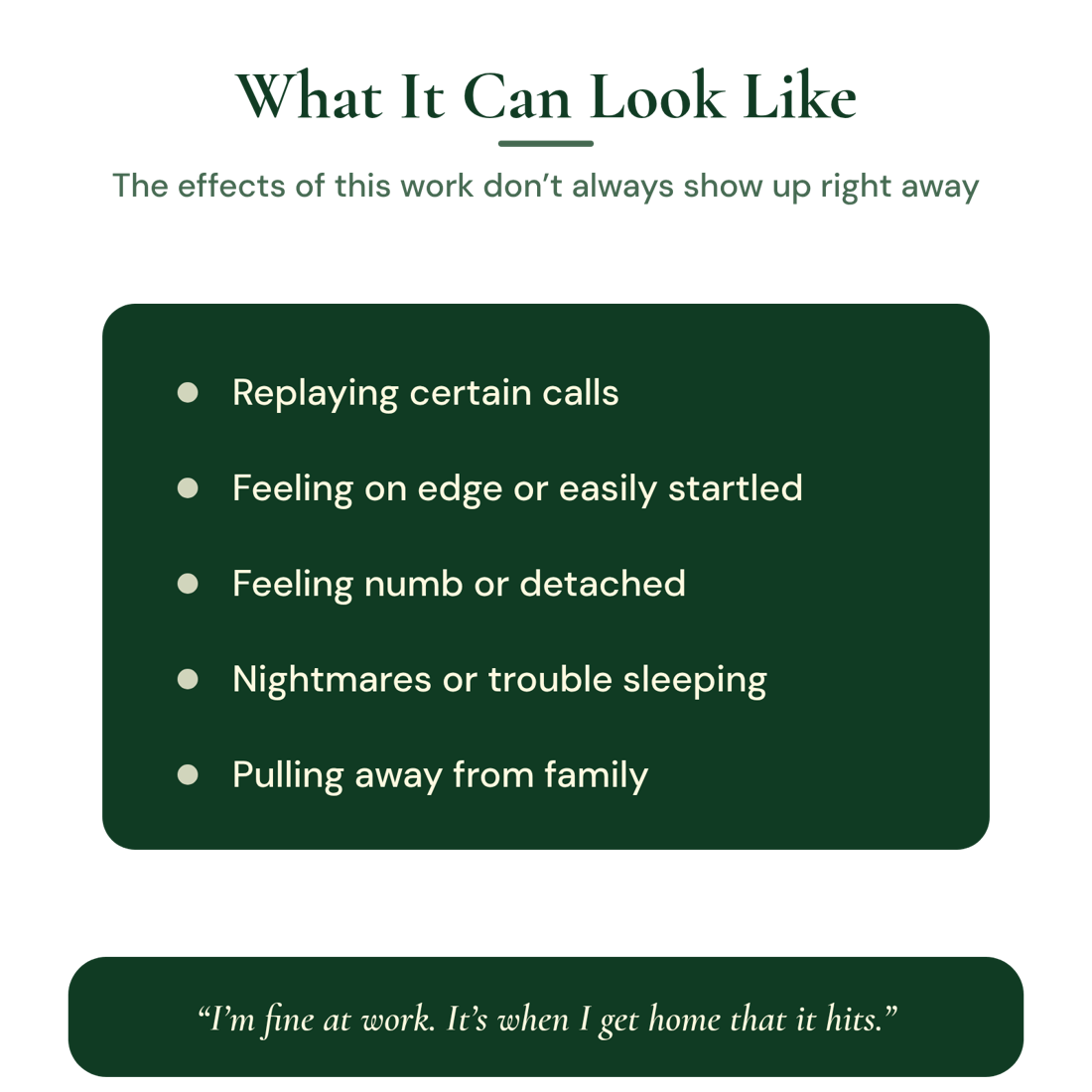
The effects of this work don’t always show up right away. And they don’t always look the way you’d expect.
You might notice:
- Replaying certain calls, patients, or incidents
- Intrusive images or memories
- Nightmares or difficulty sleeping
- Feeling constantly on edge or hypervigilant
- Being easily startled
- Irritability or anger
- Feeling numb or detached
- Losing interest in things you used to enjoy
- Pulling away from family and friends
- Dreading certain types of calls or shifts
- Avoiding reminders of a specific incident
- Feeling cynical about people or the job
- Exhaustion that rest doesn’t fix
- Difficulty concentrating
- Drinking more or using other ways to switch off
- Guilt about something you did or didn’t do
- Feeling like no one outside the job understands
- Tension in your relationship
- Feeling disconnected from your kids
- Physical symptoms like headaches, tension, or stomach problems
- Questioning whether you can keep doing this work
- Feeling like you’re just going through the motions
Sometimes people tell us:
“I’m fine at work. It’s when I get home that it hits.”
Or:
“I don’t feel anything anymore. Is that normal?” These are both things we can talk about.
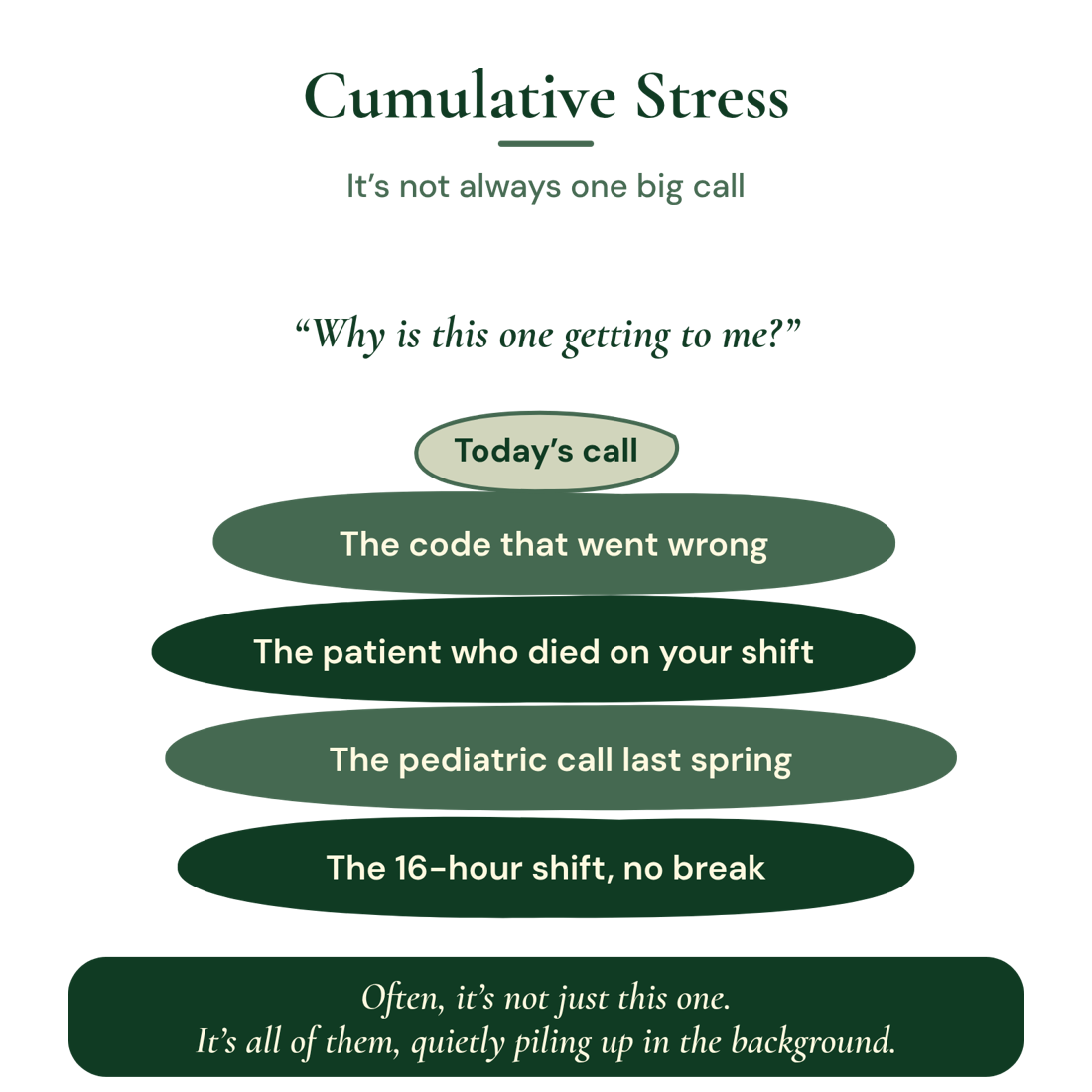
Cumulative Stress: It’s Not Always One Big Call
People often assume trauma comes from one terrible incident. Sometimes it does. But for many first responders and healthcare workers, it’s the accumulation. The pediatric call last spring. The patient who died on your shift. The overdose you’ve responded to six times. The family member’s scream you can still hear. The code that went wrong.
The violent patient. The 16-hour shift with no break. Then another one. Each one gets filed away. You tell yourself you’re fine. And for a long time, you might be. Until something small, maybe a call that wasn’t even that bad, finally tips you over.
And you think:
“Why is this one getting to me?” Often, it’s not just this one. It’s all of them. Therapy can help you make sense of what you’ve been carrying, so it isn’t quietly piling up in the background.
Not Sure Who to See? We’ll Match You.
Tell us a little about what’s going on and we’ll suggest the therapist who fits.
Critical Incidents
Some calls are different. A line-of-duty death. A child. A mass-casualty event. A call involving someone you know. A situation where you feared for your own life. A patient outcome that still keeps you up at night. After a critical incident, it’s common to have strong reactions. Shock. Racing thoughts. Trouble sleeping. Replaying what happened.
Wondering if you could have done something differently. For some people, these reactions ease over the following days and weeks. For others, they linger or show up later. Both are human responses to an inhuman situation. Therapy can give you a place to process a critical incident at your own pace, without having to tell the story over and over before you’re ready.
Trauma & PTSD Symptoms
Repeated exposure to traumatic events can affect how your brain and body respond to the world.
You might notice symptoms that are sometimes associated with post-traumatic stress, such as:
- Intrusive memories, flashbacks, or nightmares
- Avoiding people, places, or situations that remind you of what happened
- Feeling constantly on guard
- Being jumpy or easily startled
- Feeling detached from the people around you
- Negative changes in mood or beliefs about yourself, others, or the world
- Difficulty sleeping or concentrating
You don’t need a diagnosis to start therapy. And you don’t need to decide whether what you’re experiencing “counts” as trauma. If something you’ve seen or done at work is still affecting you, that’s enough of a reason to talk about it. Therapy can help you understand your reactions, reduce how much they interfere with your life, and process difficult experiences in a way that feels manageable.
Moral Injury
Sometimes the hardest part of the job isn’t fear. It’s the feeling that something wasn’t right. You had to make an impossible decision. You couldn’t give a patient the care they needed because there weren’t enough beds, staff, or time. You followed a policy that went against your values. You witnessed something you couldn’t stop.
You did everything right and it still wasn’t enough. Moral injury describes the distress that can come from doing, failing to prevent, or witnessing something that goes against your deeply held sense of right and wrong. It can show up as guilt, shame, anger, betrayal, or a loss of faith in your organization, the system or yourself.
“I didn’t sign up for this.” “I should have done more.” “How am I supposed to keep showing up to a system that keeps letting people down?” Moral injury isn’t the same as PTSD, though they can overlap. Therapy can help you make room for these feelings, explore what they mean to you, and find a way to carry them that doesn’t eat away at you.
Compassion Fatigue & Burnout
You got into this work because you care. That’s the thing. Caring is part of what makes you good at the job. It’s also part of what makes it so exhausting. Compassion fatigue can happen when you’ve been giving emotional care to others for so long that your own reserves run dry. You might notice you feel less empathy than you used to.
You’re more impatient with patients or the public. You dread going to work. You feel guilty for not caring as much as you think you should.
Burnout often comes along with it:
Emotional exhaustion. Cynicism. Feeling detached. Feeling like nothing you do makes a difference. “I used to love this job. Now I just count down the hours.” None of this means you’re a bad nurse, medic, officer, physician or worker. It may mean you’ve been running on empty for a long time. Therapy can help you understand what’s draining you, reconnect with what matters to you, and find ways to keep caring without losing yourself in the process.
Shift Work, Sleep & Never Fully Switching Off
Nights. Days. Back-to-back shifts. Being on call. Sleeping at 9 a.m. with blackout curtains while the rest of the world mows its lawn. Shift work can wreak havoc on your sleep, your mood, your relationships and your ability to be present for life outside work. And even when you’re off, your brain may not be. You’re lying awake replaying the shift.
You’re scanning restaurants for exits. You’re tensing up at the sound of sirens. You can’t remember the last time you felt fully rested. Therapy can’t change your schedule. But it can help you build strategies for sleep, rest, and recovery that fit the reality of your work and help you understand when sleep problems may be connected to stress or trauma.
The Impact on Your Family & Relationships
The job doesn’t always stay at work. It comes home in your mood. Your patience. Your energy. Your sleep. Your silence. Your partner might feel shut out. Your kids might notice you’re short-tempered or distracted. You might miss birthdays, holidays, and hockey games because of your schedule. And when you are home, you may not have much left to give.
You might also be protecting your family from what you’ve seen. Not telling them about the call. Not wanting to bring it into the house. Which makes sense. But it can also leave you carrying it alone, and leave them wondering why you feel so far away. Therapy can help you understand how the work is affecting your relationships, find ways to reconnect, and figure out what you want to share and how, with the people closest to you.

The Culture of “Just Push Through”
A lot of first responder and healthcare cultures have an unspoken rule:
Suck it up. Don’t let it get to you. Leave it at the door. Everyone sees bad stuff. Deal with it. And honestly, in the moment, that mindset can be useful. You need to keep functioning during the call, the code, or the crisis. The problem is when “push through” becomes the only option, forever. When you never get to set it down.
Dark humour, adrenaline, staying busy and not thinking about it can get you through a shift. They aren’t always enough to get you through a career. Pushing through isn’t the same as being okay. And needing support doesn’t mean you’re not tough enough. It might mean you’ve been tough for long enough.
“What Will People at Work Think?”
For many first responders and healthcare workers, one of the biggest barriers to therapy isn’t the therapy itself. It’s what it might mean. “Will people think I can’t handle it?” “Will this affect how I’m seen by my supervisor or my crew?” “Will they still trust me on a call?” “What if someone finds out?” These worries make sense, especially in workplaces where reputation and trust matter so much.
Therapy is confidential, with legal and professional limits. Your therapist will explain exactly what that means at the start, so you know what to expect. You get to decide who, if anyone, at work knows you’re in therapy. And seeing a therapist outside your workplace can give you somewhere to be completely honest without worrying about how it lands with your team.
How Can Therapy Help First Responders & Healthcare Workers?
Therapy won’t make the job less demanding. And no one can un-see what you’ve seen. But therapy can help you carry it differently.
Depending on what you’re experiencing, therapy may help you:
- Process critical incidents
- Make sense of cumulative stress
- Reduce intrusive memories and nightmares
- Feel less on edge
- Understand trauma reactions
- Work through guilt and moral injury
- Recover from burnout and compassion fatigue
- Improve sleep habits around shift work
- Manage anger and irritability
- Reconnect with emotions after feeling numb
- Reduce reliance on alcohol or other ways of switching off
- Strengthen relationships at home
- Talk with your family about the job in ways that feel right to you
- Set boundaries between work and home
- Build coping strategies that work in real life
- Navigate a return to work after time away
- Reflect on your career and what you want next
- Reconnect with the reasons you chose this work
- Reconnect with yourself
Sometimes therapy is about processing a specific call that won’t let go. Sometimes it’s about figuring out how to get through next week’s run of nights. Usually there’s room for both.
Ready When You Are. Let’s Talk.
A free 15-minute consultation is the easiest first step. Book online in a minute, or give us a call.
Our Approach to First Responder & Healthcare Worker Therapy
Many first responders and healthcare workers want therapy that’s direct, practical, and doesn’t waste time. And some things need room to be felt, not just fixed. Our therapists use a trauma-informed approach, which means we prioritize your sense of safety and control, move at a pace that feels manageable and never push you to share details before you’re ready.
We draw from evidence-informed approaches including Cognitive Behavioural Therapy (CBT), Acceptance and Commitment Therapy (ACT), Dialectical Behaviour Therapy (DBT), Emotion-Focused Therapy (EFT), somatic approaches, and person-centred therapy.
That might look like:
Understanding how stress and trauma affect your brain and body. Learning practical tools for sleep, grounding, and managing hypervigilance. Looking at the thoughts that keep you stuck, like “I should have done more.” Making room for difficult emotions instead of constantly fighting them. Clarifying what matters to you, at work and outside of it.
And processing the experiences that are still weighing on you, at a pace you choose.
Therapy That Feels Human
You don’t have to clean anything up for us. Not your language. Not your dark humour. Not the details of what you’ve seen, when and if you’re ready to share them. We want therapy to feel like a real conversation with a real person. You can tell us you don’t really believe in therapy. You can tell us you’re only here because your partner made you.
You can swear. You can laugh at things other people might find inappropriate.
You can say:
“I don’t even know where to start.” You can tell us something isn’t working. We’re not going to flinch, and we’re not going to judge you. You spend your working life taking care of other people. This is a place where someone takes care of you for a change.
First Responder & Healthcare Worker Therapy in Oakville
Heart of Oak Psychotherapy provides in-person therapy in Oakville, Ontario for paramedics, police officers, firefighters, dispatchers, corrections officers, nurses, physicians, personal support workers, and other healthcare workers navigating cumulative stress, critical incidents, trauma, moral injury, compassion fatigue, burnout, sleep difficulties and the impact of the job on their relationships and well-being.
Our therapy offices are located in a residential home in Oakville. All sessions are by appointment only. Many people find that feels more comfortable than a clinical office. You don’t need a diagnosis. You don’t need to be in crisis. If the job is taking a toll, that’s enough of a reason to start.
Online First Responder & Healthcare Worker Therapy in Ontario & Select Provinces
We also provide online therapy for first responders and healthcare workers throughout Ontario and select provinces and territories. Virtual therapy can make it easier to fit sessions around rotating shifts, nights, overtime and family life, without adding a commute. It can also offer an extra layer of privacy if you’d rather not be seen walking into a therapist’s office in your community.
Whether you’re looking for first responder therapy in Oakville or online counselling for healthcare workers elsewhere in Ontario, we’ll help you find a therapist whose experience, personality, approach and availability fit what you’re looking for.
Your therapist
Therapists Who Work With First Responders & Healthcare Workers
Book a free 15-minute consultation with any of us, or let us suggest who fits. Meet the whole team →


Cost & insurance
What Sessions Cost
Individual therapy
- 15-minute consultationFree
- 30-minute session$105
- 50-minute session$160
- 75-minute session$240
- 100-minute session$320
- Receipts are provided for extended health benefits. Many plans that cover a Registered Psychotherapist (Qualifying) will reimburse sessions. Please check your plan to confirm your coverage.
- We don’t direct bill insurance or work with EAPs.
Questions
Frequently Asked Questions About Therapy for First Responders & Healthcare Workers
Can’t find your answer? Call (289) 201-1951 or email hello@heartofoakpsychotherapy.com.
Do I need a PTSD diagnosis to come to therapy?
No. You can come to therapy because of a specific call, years of accumulated stress, burnout, trouble sleeping, relationship strain or simply because you don’t feel like yourself anymore. You don’t need a diagnosis to deserve support.
Will I have to talk about the worst calls right away?
No. Therapy should move at a pace that feels manageable for you. Many people start by talking about how things are going now, such as sleep, stress, relationships and work, before getting into specific incidents. You stay in control of what you share and when.
Will my employer find out I’m in therapy?
Therapy is confidential, with legal and professional limits. Your therapist will explain those limits clearly at the start, so you know exactly what to expect. Outside of those limits, you decide who, if anyone, knows you’re in therapy.
Can therapy help if I’m not sure it was “that bad”?
Yes. A lot of first responders and healthcare workers compare their experiences to colleagues who have “seen worse.” But there’s no threshold you have to reach. If something is affecting you, it matters.
What’s moral injury, and is it the same as PTSD?
Moral injury refers to the distress that can come from doing, failing to prevent, or witnessing something that goes against your deeply held values. It often involves guilt, shame, anger or a sense of betrayal. It isn’t the same as PTSD, although the two can overlap. Therapy can help with both.
Do you work with healthcare workers who aren’t nurses or doctors?
Yes. We welcome personal support workers, respiratory therapists, pharmacists, social workers, hospital staff, long-term care workers and anyone else whose work involves caring for people in difficult circumstances.
Can my partner or family get support too?
The job affects the whole family. Family members can seek their own support, and relationship or family-focused therapy may also be an option. We can talk with you about what might be most helpful.
What if I need help right now?
If you are in crisis or thinking about suicide, call or text 9-8-8 (Suicide Crisis Helpline) any time, or call 911 or go to your nearest emergency department if you are in immediate danger. Therapy is not an emergency service, but we’re here for ongoing support once you’re safe.
Free 15-minute consultation
Not Sure Who to See? We’ll Match You.
Finding the right fit matters more than finding the perfect words. Answer two quick questions and book a free consultation; we’ll point you to the therapist who suits what you’re looking for.
You Don’t Have to Carry It All by Yourself
You’ve spent your career showing up for other people. Running toward what everyone else is running from. Staying steady when things are chaotic. Holding space for people on the worst days of their lives. You’re allowed to need something too. Imagine sleeping through the night more often. Coming home and actually being present.
Thinking about a hard call without it taking over your day. Feeling like yourself again, at work and at home. Asking for support isn’t the opposite of strength. Sometimes it’s what makes it possible to keep doing the work you care about.
Not sure which therapist is right for you?
You make enough high-stakes decisions at work. This one doesn’t have to be one of them. Take our matching quiz or book a free 15-minute consultation with Katarina Jurriaans. She’ll learn a little about your work, what’s been weighing on you, and what kind of therapist you think you’d connect with, then help match you based on areas of focus, approach, personality and availability.
Book your free consultation. You’ve had everyone else’s back for a long time. Let someone have yours.
Other ways we can help
Something Else on Your Mind? We Can Help With That Too.
Many people come in for one thing and find it’s connected to another. Explore the other areas our therapists work with.
Not sure it fits a box?
Most people aren’t. Book a free 15-minute consultation and we’ll help you sort out where to start.
Help me choose a therapist →Virtual therapySecure video sessions in Ontario & select provinces›AnxietyWorry, panic, racing thoughts›DepressionLow mood, numbness, no energy›Trauma & PTSDAfter one hard event, or years of them›Preteens & teensSchool, friendships, big feelings›Grief, loss & pet lossIncluding the loss of a pet›Eating disorders & body imageFood, body and self-worth›OCDIntrusive thoughts, doubt, compulsions›ADHDFocus, overwhelm, follow-through›Men’s therapyStress, anger, pressure to cope alone›Stress & life transitionsBurnout, change, new chapters›Relationships & datingPatterns, dating, attachment›LGBTQIA+ affirming careBe fully yourself in the room›Couples therapyConflict, distance, reconnecting›Family therapyParents, kids and the space between›Self-esteem & confidenceThe inner critic, people-pleasing, comparison›Not sure? We’ll match youTell us what’s going on›