When your brain won't let you let it go
What if I left the stove on? What if I accidentally hurt someone? What if I'm secretly a bad person? What if I'm sick and don't know it? What if I said something offensive? What if I don't actually love my partner? You know you've already checked. You know you've already asked someone for reassurance. You know you've spent hours trying to figure it out. But your brain wants certainty. So you check one more time. Replay the conversation again. Google the symptom. Ask someone what they think. Review what happened in your head. Avoid the thing entirely. Or tell yourself: “I just need to figure this out, and then I'll finally feel better.”
For a little while, maybe you do. And then another doubt shows up. We provide OCD therapy in Oakville and online across Ontario for preteens, teens, and adults experiencing intrusive thoughts, obsessions, compulsions, checking, reassurance seeking, mental rituals, avoidance, and the exhausting need to feel completely certain.
OCD can make you question the things that matter most to you. You don't have to figure those questions out alone.
What Is OCD?
Obsessive-Compulsive Disorder (OCD) is a mental health condition involving obsessions, compulsions, or both that can become time-consuming, distressing, or interfere with everyday life. Obsessions are recurring thoughts, images, urges, or doubts that feel intrusive or unwanted and cause significant anxiety or distress. Compulsions are behaviours or mental acts someone feels driven to perform in response to an obsession or according to rigid internal rules.
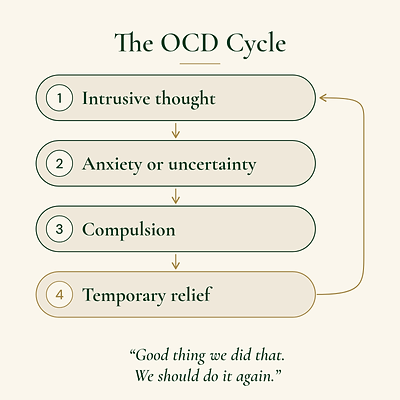
The basic cycle can look something like:
Intrusive thought → anxiety or uncertainty → compulsion → temporary relief → intrusive thought returns. The relief matters.
When doing something makes anxiety go away, even temporarily, your brain learns:
“Good thing we did that. We should do it again next time.” And the cycle gets stronger. OCD treatment can help you begin changing that relationship with uncertainty.
OCD Is More Than Being Organized
People casually say things like:
“I'm so OCD about my kitchen.”
Or:
“Everything has to be organized. I'm definitely OCD.” But OCD isn't simply liking things clean, being particular, or wanting your desk organized. For someone actually living with OCD, symptoms can be frightening, exhausting, embarrassing, confusing, and incredibly time-consuming. Some people spend hours checking. Others perform rituals nobody else can see.
Some avoid people, places, objects, situations, or even thoughts because they're terrified of what might happen. And many people with OCD know that their fears or rituals may seem excessive—but still feel unable to stop. That's very different from simply liking things a certain way.
What Can OCD Look Like?
OCD can look dramatically different from one person to another.
You might experience:
-
Intrusive thoughts or images
-
Persistent “what if?” thoughts
-
Checking locks, appliances, messages, or other things repeatedly
-
Repeating behaviours until they feel “right”
-
Excessive washing or cleaning
-
Fear of contamination
-
Asking other people for reassurance
-
Confessing things repeatedly
-
Googling questions over and over
-
Reviewing conversations in your mind
-
Mentally checking how you felt in a particular moment
-
Repeating words, numbers, prayers, or phrases internally
-
Trying to replace a “bad” thought with a “good” thought
-
Counting
-
Avoiding particular people, places, objects, or situations
-
Difficulty throwing things away because something bad might happen
-
Constantly questioning your memories
-
Feeling responsible for preventing bad things from happening
-
Needing absolute certainty before making decisions
-
Becoming extremely distressed by intrusive thoughts that conflict with your values
Compulsions aren't always visible. Someone may look completely calm while spending hours performing rituals inside their head.
Intrusive Thoughts & OCD
One of the most distressing parts of OCD can be intrusive thoughts. An intrusive thought can involve something completely inconsistent with who you believe yourself to be.
And because the thought feels so disturbing, you may immediately ask:
“Why would I think that?” “What does that say about me?” “What if having the thought means I secretly want it?” Then you begin analyzing. Checking your feelings. Reviewing memories. Searching online. Avoiding situations. Asking for reassurance. Trying to prove the thought isn't true. The problem is that trying to achieve complete certainty can keep you trapped in the OCD cycle.
Having an unwanted thought isn't the same as wanting it, agreeing with it, or acting on it. Therapy can help you learn to respond to intrusive thoughts differently instead of treating every thought your brain produces as something that needs to be investigated.
Different OCD Themes
OCD can attach itself to almost anything. Themes can also change over time. Sometimes one fear finally quiets down only for OCD to find something new.
Contamination OCD
You may fear germs, illness, bodily fluids, chemicals, contamination, or spreading something harmful to another person. Compulsions might involve washing, cleaning, changing clothes, avoiding objects, researching risks, or seeking reassurance.
Checking OCD
You may repeatedly check doors, appliances, vehicles, emails, assignments, messages, or other things because you're afraid something bad could happen if you made a mistake.
Even after checking, doubt returns:
“But did I actually check properly?”
Harm OCD
Harm-related OCD can involve unwanted thoughts, images, or fears about harming yourself or another person. Because these thoughts can feel completely opposite to your values, they may be especially frightening. You might avoid certain people, objects, places, or situations or repeatedly check whether you're capable of doing something terrible.
Relationship OCD
Relationship OCD, sometimes called ROCD, can involve persistent doubts about your relationship. Do I really love them? Are they actually right for me? Am I attracted enough to them? What if there's someone better? You may repeatedly check your feelings, compare your relationship to others, analyze your partner's characteristics, research relationships, or seek reassurance.
The search for absolute certainty can make it increasingly difficult to simply experience the relationship you're trying so hard to understand.
Sexual or Identity-Related OCD Themes
OCD can involve intrusive doubts or fears related to sexuality, sexual orientation, gender, identity, or unwanted sexual thoughts. The distress isn't simply the existence of uncertainty around identity. Rather, in OCD, the person can become trapped in repetitive checking, analyzing, reassurance seeking, or attempts to achieve absolute certainty.
A therapist needs to approach these concerns carefully and without assuming that identity exploration itself is pathological.
Religious or Moral OCD
Sometimes called scrupulosity, this can involve intense fears about morality, religion, sin, honesty, or being a “good” person. You may repeatedly confess, seek reassurance, mentally review your actions, pray compulsively, or analyze whether your intentions were morally acceptable.
“Just Right” OCD
Sometimes OCD isn't driven by a specific feared catastrophe. Something simply feels wrong or incomplete. You may repeat actions, arrange objects, rewrite things, reread sentences, or perform behaviours until you finally get the elusive feeling that it's “right.”
Mental Compulsions
Not every compulsion can be seen. This is one reason OCD can go unnoticed.
Mental compulsions can include:
-
Reviewing memories
-
Replaying conversations
-
Checking your emotional response
-
Trying to determine what a thought “really means”
-
Mentally reassuring yourself
-
Repeating phrases
-
Counting internally
-
Trying to cancel out unwanted thoughts
-
Comparing current feelings to previous feelings
-
Mentally testing yourself
-
Trying to prove something with absolute certainty
Because these happen internally, you may not even recognize them as compulsions. It may simply feel like thinking. But if you're repeatedly trying to solve the same question and never reaching an answer that feels certain enough, OCD may be keeping you in the loop.
OCD & Reassurance Seeking
Reassurance can feel incredibly good when you're anxious.
You ask:
“Do you think I'm okay?” They say yes. Immediate relief.
Until twenty minutes later:
“But what if I didn't explain it properly?” So you ask again. Reassurance can come from partners, parents, friends, therapists, doctors, Google, Reddit, or even yourself. The problem isn't that reassurance is inherently bad. It's that when reassurance becomes a compulsion, repeatedly receiving it can unintentionally teach your brain that you needed reassurance to be safe.
OCD treatment may involve learning how to tolerate uncertainty without repeatedly trying to make the uncomfortable feeling disappear.
OCD, Anxiety & Perfectionism
OCD can overlap with anxiety and perfectionism, but they're not necessarily the same thing. Someone with generalized anxiety may worry about many realistic areas of life. Someone with perfectionism may hold themselves to extremely high standards. OCD typically involves patterns of intrusive obsessions and compulsions performed in response to distress or rigid internal rules.
Of course, one person can experience more than one of these at the same time. Part of therapy is understanding what is actually driving the behaviour so treatment can match what's happening.
How Can Therapy Help With OCD?
The frustrating thing about OCD is that many of the things you do to feel safer can unintentionally keep the cycle going. Checking makes you feel better. Avoiding makes you feel better. Reassurance makes you feel better. Researching makes you feel better. Performing the ritual makes you feel better. At least temporarily. OCD therapy can help you understand that cycle and gradually change your response to it.
Depending on your needs, therapy may help you:
-
Understand how OCD works
-
Identify obsessions and compulsions
-
Recognize mental compulsions
-
Understand reassurance-seeking patterns
-
Reduce avoidance
-
Develop greater tolerance for uncertainty
-
Respond differently to intrusive thoughts
-
Reduce compulsive checking
-
Build distress-tolerance skills
-
Understand family accommodation
-
Develop strategies for emotional regulation
-
Address shame surrounding intrusive thoughts
-
Reduce the amount of time OCD consumes
-
Reconnect with relationships and activities OCD has interfered with
-
Build confidence in your ability to experience uncertainty without immediately fixing it
The goal isn't to prove that every fear you have will never happen. No therapist can give anyone absolute certainty about life.
The goal is to help you become increasingly able to say:
“Maybe. Maybe not. I don't need to solve this right now.” And keep living your life.
Exposure and Response Prevention (ERP) for OCD
One of the most established psychological treatments for OCD is Exposure and Response Prevention (ERP), a form of cognitive behavioural therapy. ERP involves gradually and collaboratively approaching situations, thoughts, sensations, or uncertainty that trigger OCD while practising not performing the usual compulsion intended to reduce distress.
That might sound intimidating. Good ERP isn't about a therapist suddenly throwing you into your biggest fear. Treatment should be collaborative and appropriately paced.
Over time, you can learn something incredibly important:
Anxiety and uncertainty can show up—and you don't have to perform a ritual every time they do. The goal isn't to make you love uncertainty. It's to help you stop organizing your entire life around trying to eliminate it.
Our Approach to OCD Therapy
OCD deserves treatment that actually understands OCD. Depending on the therapist, your needs, and whether OCD is the primary concern, treatment may incorporate approaches such as Exposure and Response Prevention (ERP), Cognitive Behavioural Therapy (CBT), Acceptance and Commitment Therapy (ACT), and Dialectical Behaviour Therapy (DBT) alongside person-centred and other evidence-informed approaches.
We may also work with concerns happening alongside OCD, including anxiety, depression, ADHD, perfectionism, shame, relationship difficulties, and low self-esteem.
But there's an important distinction:
We don't want therapy itself to become another compulsion.
If OCD asks:
“Can you promise me this thought doesn't mean anything?” Repeatedly providing certainty can strengthen the exact cycle we're trying to change. Instead, we'll help you learn how to handle the discomfort of not knowing with complete certainty. It can feel difficult at first. But that's where freedom from the cycle can start.
Therapy That Feels Human
OCD can make people afraid to tell a therapist what they're actually thinking.
You might worry:
“What if they think I'm dangerous?” “What if they've never heard anything this weird before?” “What if they judge me?” “What if saying the thought out loud somehow makes it more real?” You don't need to sanitize your OCD for us. We want therapy to feel warm, collaborative, comfortable, and genuinely human—even when the things you're talking about feel uncomfortable.
You can tell us the thought you're embarrassed about. You can say, “This is going to sound ridiculous.” You can tell us you're terrified to stop doing a compulsion. You can laugh at how creative OCD can get. You can tell us an exercise feels too difficult. And you can ask us why we're recommending something instead of simply being told what to do.
We won't reduce you to your intrusive thoughts. You're a person whose brain has become very good at sounding an alarm. We'll work together on helping you respond differently when it does.
OCD Therapy in Oakville
Heart of Oak Psychotherapy provides in-person OCD therapy in Oakville, Ontario for preteens, teens, and adults experiencing obsessions, intrusive thoughts, compulsions, checking, reassurance seeking, mental rituals, avoidance, and other OCD-related concerns. Our therapists can also support concerns that may occur alongside OCD, including anxiety, depression, ADHD, perfectionism, relationship difficulties, emotional regulation, and self-esteem.
Whether you've been diagnosed with OCD, suspect you may have it, or simply know you've become trapped in repetitive thoughts and behaviours that are interfering with your life, we can start with what you're experiencing.
Online OCD Therapy Across Ontario
We also provide online OCD therapy throughout Ontario. Virtual therapy can be particularly useful for OCD treatment because many triggers and compulsions happen in your everyday environment. Depending on your needs and treatment plan, therapy can help you understand and practise new responses to OCD while you're in the spaces where your life actually happens.
Whether you're looking for OCD therapy in Oakville or online OCD support elsewhere in Ontario, we'll help you find a therapist whose experience, therapeutic approach, personality, and availability fit what you're looking for.
Frequently Asked Questions About OCD Therapy
Do I need an OCD diagnosis to start therapy?
No. You may already have an OCD diagnosis, suspect that you have OCD, or simply know that intrusive thoughts, checking, reassurance seeking, rituals, or repetitive doubt are interfering with your life. You don't need to diagnose yourself before asking for help.
Are intrusive thoughts normal?
Unwanted or strange thoughts can occur in people with and without OCD. With OCD, the problem often becomes the meaning attached to the thought and the repetitive attempts to obtain certainty or reduce the distress it causes. Therapy can help you change your relationship with intrusive thoughts rather than trying to control every thought your brain produces.
Do intrusive thoughts mean I secretly want to do them?
An unwanted thought is not the same thing as an intention or action. OCD can make people intensely focused on determining exactly what a thought means, which can lead to further checking and analysis. Rather than endlessly trying to prove what a thought does or doesn't mean, OCD treatment can help you step out of that cycle.
Will therapy make me stop doing my compulsions immediately?
OCD treatment should be collaborative. Reducing compulsions can feel extremely uncomfortable because they've often become your brain's way of creating temporary relief. Treatment can involve gradually building your ability to experience anxiety or uncertainty without relying on the same compulsive response.
What is ERP?
Exposure and Response Prevention is an evidence-based psychological treatment for OCD. It involves intentionally and gradually facing OCD triggers or uncertainty while reducing the compulsions normally used to relieve distress. Your therapist can explain how ERP applies to your specific OCD symptoms and work collaboratively with you around treatment.
Is reassurance part of OCD?
It can be. Repeatedly asking someone to confirm that you're safe, haven't done anything wrong, aren't a bad person, aren't sick, or made the correct decision can function as a compulsion when it's being used to neutralize OCD-related uncertainty. The relief tends to be temporary—which is why you may find yourself needing reassurance again.
Can children and teens have OCD?
Yes. OCD can occur in children and adolescents, and symptoms may sometimes involve the entire family as parents understandably try to reduce their child's distress. Therapy can help young people learn how OCD works while helping parents understand how to support treatment.
Can OCD go away?
OCD is treatable, and many people experience substantial improvement with appropriate treatment. The goal isn't necessarily to guarantee you'll never experience another intrusive thought. It's to help those thoughts and urges have far less control over what you do and how you live.
You Don't Have to Solve Every “What If?”
Imagine having an intrusive thought and letting it pass without spending the next two hours analyzing it. Leaving the house without checking one more time. Sending the message without rereading it until it feels perfect. Feeling uncertainty without immediately asking someone to reassure you.
Having a thought you don't like and knowing:
“A thought can just be a thought.”
Maybe your brain says:
But what if?
And instead of spending the rest of your day trying to answer it, you're able to say:
“I don't know.” And go back to living. That's not giving up. That's learning that you don't need absolute certainty to be okay. We offer OCD therapy in Oakville and online throughout Ontario for preteens, teens, and adults.
Not sure which therapist is right for you?
You don't have to figure that out alone. Submit our Intake Form or book a free consultation with Katarina Jurriaans. She'll learn a little about what you're experiencing and what you're looking for, then help match you with a therapist based on their specialties, therapeutic approach, personality, and availability. Book your free consultation and start taking back some of the space OCD has been occupying.