
Mairin
Registered Psychotherapist (Qualifying)
Sees: Preteens, teens, adults, and first responders & healthcare workers

When your brain just won't turn off





Tell us a little about what’s going on and we’ll suggest the therapist who fits.
We’ll match you →You replay conversations from three days ago. You think about everything that could go wrong before anything has even happened. You overthink decisions, second-guess yourself, prepare for every possible outcome, and still somehow never feel completely prepared. Maybe your anxiety is obvious. Your heart races. Your chest feels tight. You feel restless, shaky, nauseous, or panicked.
Or maybe no one would know you're anxious at all. You're responsible. Successful. Organized. The person everyone else relies on.
But underneath it all, your brain is constantly going:
“What if?”
Anxiety can be exhausting—especially when you've been living with it for so long that being on edge has started to feel normal. We provide anxiety therapy in Oakville and online therapy across Ontario and select provinces and territories for preteens, teens, and adults who are tired of overthinking everything, constantly worrying, avoiding things because of fear, or feeling like their nervous system never fully switches off.
You don't need to “just stop worrying.” Let's figure out why your brain is working this hard in the first place.
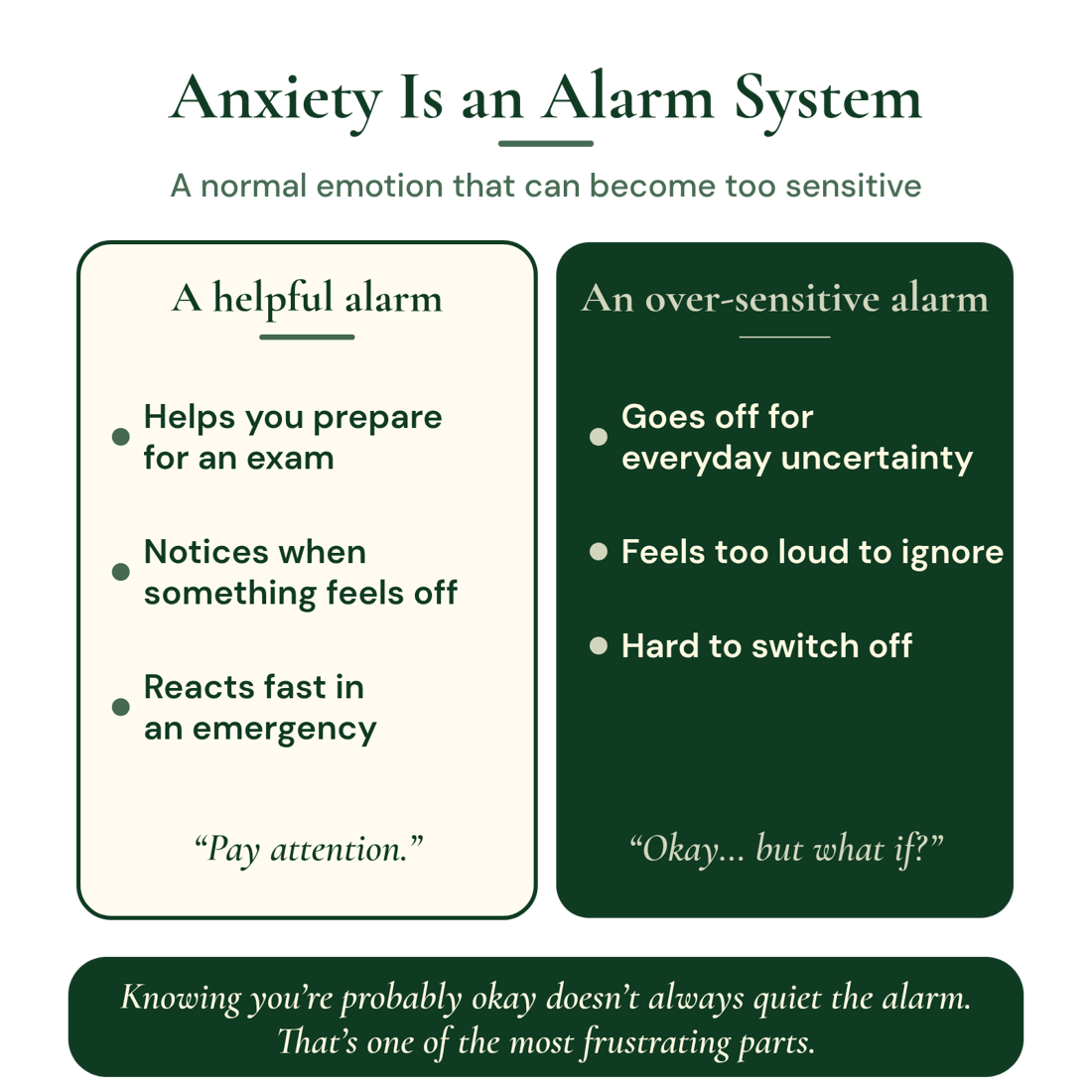
Anxiety is a normal human emotion. Our brains are designed to notice potential threats and help protect us from danger. A certain amount of anxiety can even be useful—it can motivate us to prepare for an exam, pay attention when something doesn't feel right, or respond quickly in an emergency. The problem is when that internal alarm system becomes too sensitive, too loud, or too difficult to switch off.
Your brain may start responding to uncertainty, social situations, physical sensations, mistakes, conflict, school, work, relationships, or everyday decisions as though something dangerous is happening. And knowing logically that you're probably okay doesn't always make the anxiety disappear. That's one of the most frustrating parts.
You can know you're overthinking. You can know the worst-case scenario probably isn't going to happen. You can have someone reassure you ten times.
And your brain can still say:
“Okay…but what if?”
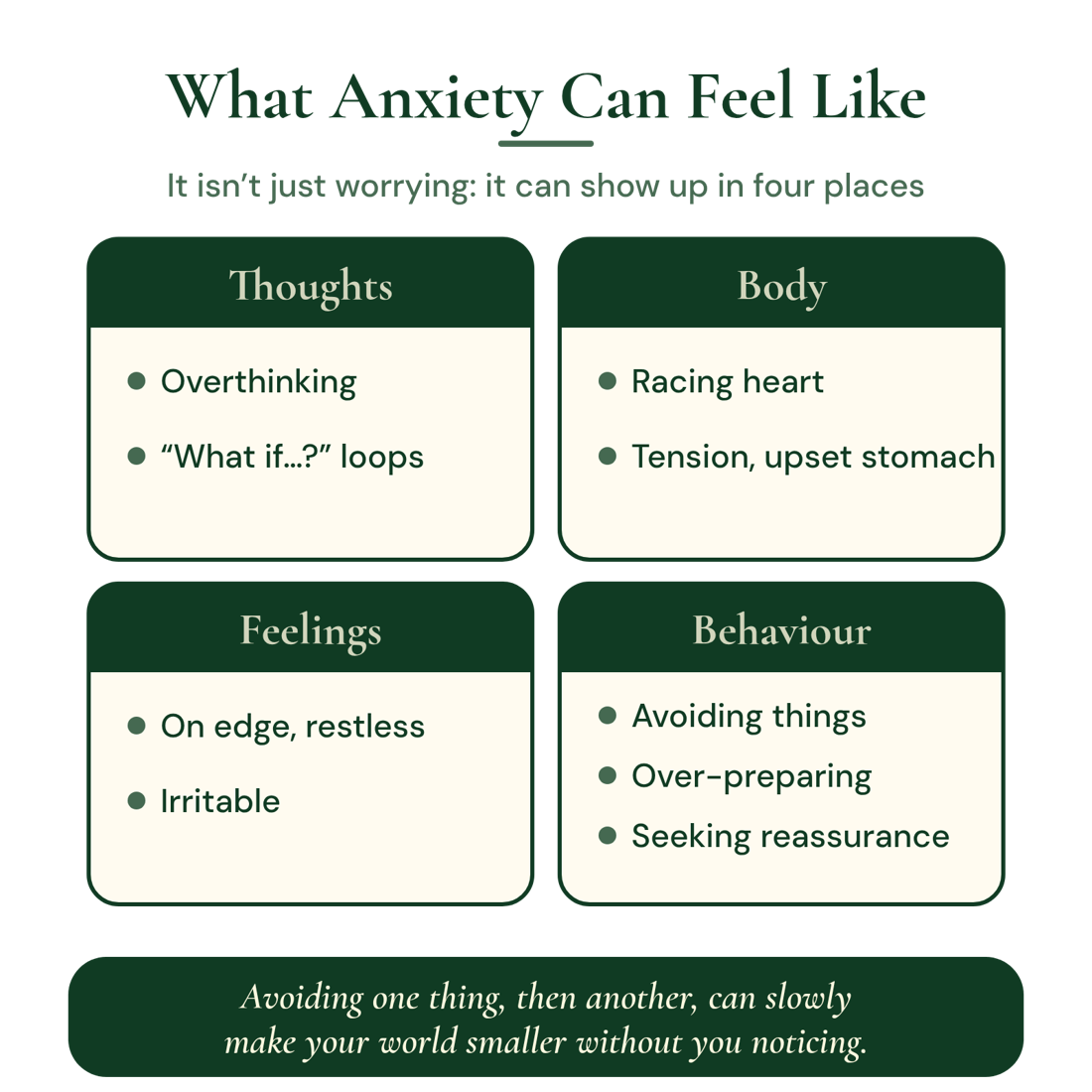
Anxiety isn't just worrying. It can affect your thoughts, emotions, body, relationships, behaviour, sleep, school, and work.
You might experience:
Sometimes anxiety makes your world smaller without you even realizing it's happening. You avoid one thing because it makes you uncomfortable. Then another. And eventually, you're organizing more and more of your life around not feeling anxious. Therapy can help you change that.
There usually isn't one single cause of anxiety. Anxiety can develop through a combination of genetics, temperament, life experiences, relationships, learned patterns, chronic stress, environmental factors, and the way your brain and nervous system respond to perceived threats. For some people, anxiety has been around for as long as they can remember.
Maybe you were always the cautious kid. The worrier. The perfectionist. The one who needed to know exactly what was happening before you felt comfortable. For others, anxiety becomes more noticeable after something changes. It might appear during a stressful period at work, after becoming a parent, following a difficult relationship, during university, after experiencing trauma or loss, during health problems, or after months or years of pushing through chronic stress.
And sometimes there isn't an obvious reason. Therapy isn't about blaming you—or your childhood, your parents, your job, or your brain. It's about getting curious about what keeps your anxiety going now and learning how to respond differently.
Tell us a little about what’s going on and we’ll suggest the therapist who fits.
Anxiety doesn't look the same for everyone. Understanding what your particular anxiety looks like can help us figure out what kind of support may be most helpful.
Generalized anxiety can feel like your brain always needs something to worry about. You might worry about work, school, finances, health, relationships, family, the future—or things that haven't even happened yet. When one worry gets resolved, another quickly takes its place. It can feel like you're constantly trying to mentally prepare yourself for every possible problem.
Social anxiety is more than being shy.
You may spend social situations monitoring yourself:
And once the interaction is over, you might replay it repeatedly looking for evidence that you embarrassed yourself or did something wrong. Social anxiety can make friendships, dating, school, work, presentations, parties, eating around others, or even everyday conversations feel exhausting.
A panic attack can involve an intense surge of fear alongside physical symptoms such as a racing heart, chest discomfort, dizziness, trembling, sweating, nausea, difficulty breathing, or feeling disconnected from reality. Because the physical sensations can be so intense, some people become afraid of having another panic attack.
Then the fear of panic itself becomes part of the anxiety.
A headache becomes:
What if something is seriously wrong? A strange sensation becomes hours of Googling. You might repeatedly check your body, seek reassurance from loved ones or healthcare professionals, or struggle to believe medical reassurance once you've received it. The relief from checking or reassurance often feels good—but only temporarily.
Then another symptom appears and the cycle begins again.
Sometimes anxiety becomes strongly connected to a particular object or situation, such as flying, driving, needles, animals, vomiting, heights, storms, or enclosed spaces. Avoidance can provide immediate relief, but over time it can strengthen the brain's belief that the feared situation really is dangerous.
Performance anxiety can show up at school, work, in sports, public speaking, interviews, auditions, or any situation where you feel evaluated. You may put enormous pressure on yourself to perform perfectly because making a mistake feels much bigger than simply making a mistake.
Sometimes anxiety attaches itself to the people we care about most. You may worry about being abandoned, whether someone is upset with you, whether your relationship is okay, whether you've done something wrong, or whether you're “too much.” This can lead to reassurance seeking, overanalyzing messages, people-pleasing, difficulty setting boundaries, or feeling extremely distressed by changes in someone's behaviour.
These three often travel together. If you're anxious, being perfect can start to feel like a way of staying safe. If you never make mistakes, maybe no one can criticize you. If everyone is happy with you, maybe no one will leave. If you're prepared for everything, maybe nothing can catch you off guard. So you work harder. Double-check everything.
Say yes when you want to say no. Rewrite the email six times. Analyze whether someone sounded different when they said “okay.” And hold yourself to standards you would never expect from another person. From the outside, this can look like being incredibly capable. Inside, it can feel exhausting. Therapy can help you build a sense of safety and self-worth that doesn't depend on being perfect or keeping everyone around you happy.
People with anxiety are often already very good at thinking. In fact, sometimes that's part of the problem. You've probably already tried reasoning with yourself. You've told yourself to calm down. You've asked friends for reassurance. You've researched the thing you're worried about. You've made lists. You've prepared. You've tried distracting yourself.
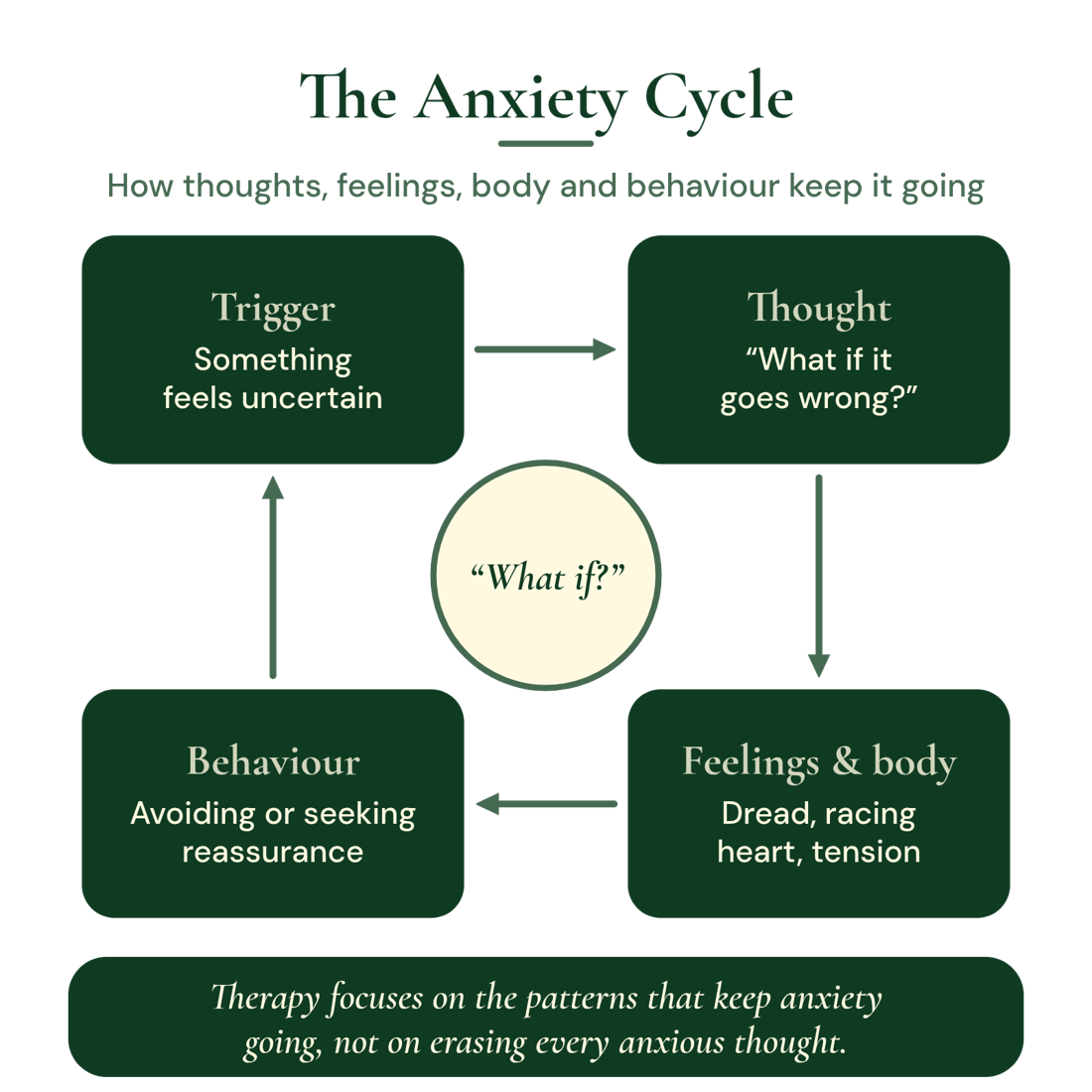
And somehow the anxiety keeps finding something new to worry about. Therapy can help you understand the patterns that keep anxiety going rather than spending your life trying to eliminate every anxious thought.
Depending on your needs, anxiety therapy may help you:
The goal isn't necessarily to never feel anxious again. Anxiety is part of being human. The goal is for anxiety to stop making so many decisions for you.
There isn't one approach that works for every person experiencing anxiety. Our therapists draw from evidence-informed approaches. Depending on what you're struggling with, therapy might be practical and skills-focused. We may look at how avoidance is reinforcing anxiety, practise tolerating uncertainty, develop emotional regulation strategies, or change how you respond when anxious thoughts show up.
Other times, we may need to go deeper. Where did you learn that mistakes aren't okay? Why does disappointing someone feel so scary? Why do you feel responsible for everyone else's emotions? Why does uncertainty feel unbearable? Why does your brain believe it has to anticipate every possible problem before you can relax? Good therapy can make room for both.
We can give you tools for Tuesday morning and understand why Tuesday morning keeps feeling this hard.

We know anxiety can make starting therapy its own source of anxiety.
You might wonder:
You don't need to perform therapy correctly. We want therapy to feel warm, comfortable, collaborative, and genuinely human. You can laugh. You can swear. You can tell us something feels awkward. You can bring up something completely unrelated halfway through the session. You can say, “I know this makes no sense, but…” You can tell us when a strategy isn't working.
And you absolutely do not need to arrive with a perfectly organized list of everything you'd like to fix. We'll figure it out together.
A free 15-minute consultation is the easiest first step. Book online in a minute, or give us a call.
We provide in-person anxiety therapy in Oakville, Ontario for preteens, teens, and adults. Our therapists support clients experiencing anxiety alongside concerns such as depression, ADHD, OCD, perfectionism, people-pleasing, relationship difficulties, eating concerns, trauma, grief, low self-esteem, school stress, workplace stress, major life transitions, and more.
Whether anxiety has been part of your life for years or has only recently become difficult to manage, therapy can help you understand what's happening and develop a different relationship with it.
We also provide virtual anxiety therapy throughout Ontario, allowing you to meet with a therapist from wherever you feel most comfortable. Online therapy can be particularly helpful when commuting, busy schedules, school, work, childcare, or anxiety itself makes getting to an office difficult. Whether you're looking for anxiety therapy in Oakville or online counselling elsewhere in Ontario, we'll help you find a therapist whose experience, personality, and approach fit what you're looking for.
Book a free 15-minute consultation with any of us, or let us suggest who fits. Meet the whole team →
Individual therapy
Can’t find your answer? Call (289) 201-1951 or email hello@heartofoakpsychotherapy.com.
There isn't a minimum level of anxiety you have to reach before you're allowed to ask for support. If worry, overthinking, panic, avoidance, perfectionism, physical anxiety, or fear is interfering with your relationships, school, work, sleep, confidence, or ability to enjoy your life, it may be worth talking about. And you don't need to wait until it becomes unbearable.
No. You don't need a formal diagnosis to see one of our therapists. You might simply know that you're worrying too much, overthinking everything, avoiding situations, experiencing panic, or feeling constantly overwhelmed. That's enough of a place to start.
The goal isn't necessarily to stop your brain from ever producing an anxious thought. Trying desperately not to think about something can sometimes make it even harder to let go of. Therapy can help you recognize when you've entered an overthinking cycle, understand what keeps that cycle going, and learn different ways of responding to uncertainty and anxious thoughts.
Over time, those thoughts don't have to take up quite so much space.
You can still benefit from therapy. When you've experienced anxiety for years, it can start to feel like it's simply part of your personality. Therapy isn't about changing who you are. It's about helping you understand which patterns are genuinely part of you and which ones developed because your brain has spent a long time trying to keep you safe.
There isn't one standard timeline. It depends on the type and severity of anxiety you're experiencing, how long you've been struggling, your goals, whether other concerns are involved, and the therapeutic approach being used. Some people come to therapy for focused support around a particular anxiety concern, while others benefit from longer-term work.
Your therapist can help you decide what makes sense for you.
That's something you can tell us. Therapy shouldn't involve forcing you to disclose everything immediately. We'll work at a pace that feels manageable while also gently helping you move toward the things anxiety may be encouraging you to avoid.
Finding the right fit matters more than finding the perfect words. Answer two quick questions and book a free consultation; we’ll point you to the therapist who suits what you’re looking for.
Who works with what, at a glance.
| Couples | Michaela, Megan |
| Preteens | Mairin, Michaela |
| Teens | Mairin, Michaela, Megan (16+), Katarina |
| Families & parenting | Michaela, Megan, Katarina |
| OCD & intrusive thoughts | Mairin, Megan (ERP: Mairin) |
| Eating disorders & body image | Megan, Katarina |
| Trauma & PTSD | Mairin, Megan, Katarina |
| ADHD & neurodivergence | Mairin, Michaela, Megan |
| Men’s mental health | Mairin (a particular focus), Michaela, Megan, Katarina |
| First responders & healthcare workers | Mairin, Megan, Katarina |
| Anxiety, stress & self-esteem | All four of us |
Not on the list? Ask us in your free consultation.
Imagine making a decision without analyzing it for the next three days. Sending the text without rereading it fifteen times. Saying no without spending the evening feeling guilty. Going somewhere without planning your escape route. Making a mistake without deciding it means you're a failure. Feeling anxious and trusting yourself to handle it anyway. You don't need to become fearless. You just deserve a life where fear isn't always in charge.
We offer anxiety therapy in Oakville and online therapy throughout Ontario and select provinces and territories for preteens, teens, and adults. Not sure which therapist is right for you? You don't need to scroll through every therapist profile trying to diagnose yourself and figure out the perfect match. Submit our Intake Form or book a free 15-minute matching call with Katarina Jurriaans. She'll learn a little about what you're experiencing and what you're looking for in a therapist, then help match you based on areas of focus, approach, personality, and availability.
Book your free consultation and let's figure out what support could look like for you.
Many people come in for one thing and find it’s connected to another. Explore the other areas our therapists work with.
Most people aren’t. Book a free 15-minute consultation and we’ll help you sort out where to start.
Book a free 15-minute matching call →