
Mairin
Registered Psychotherapist (Qualifying)
Sees: Preteens, teens, adults, and first responders & healthcare workers

Relationships are hard. Even when you really love the people in them.





Tell us a little about what’s going on and we’ll suggest the therapist who fits.
We’ll match you →Maybe you keep having the same argument with your partner. Maybe dating has become completely exhausting. Maybe you overthink every text message and wonder whether someone's losing interest. Maybe there's a friendship that hasn't felt right for a long time, but you don't know whether to address it or let it go. Maybe your relationship with your parents is complicated.
You love them. And they can also make you feel like you're fifteen years old again within approximately three minutes. Maybe you're always the person everyone comes to with their problems, but you're starting to realize nobody really knows when you're struggling.
Or maybe you've noticed a frustrating pattern:
Different person. Different relationship. Somehow, the same problem keeps showing up. We provide therapy for relationship issues and dating in Oakville and online across Ontario and select provinces and territories for teens and adults navigating romantic relationships, dating, friendships, family relationships, breakups, attachment, communication, boundaries, trust, loneliness, people-pleasing, conflict, and complicated interpersonal dynamics.
Because relationship therapy doesn't always mean couples therapy. Sometimes the most important relationship work starts with understanding yourself.
Relationship difficulties can happen in any meaningful relationship—not only romantic ones.
You may be struggling with a:
Sometimes there's an obvious conflict. Other times, nothing dramatic has happened. The relationship just doesn't feel good anymore. Maybe you feel misunderstood. Taken for granted. Responsible for keeping everyone happy. Afraid of conflict. Unable to trust. Like you're always giving more than you're receiving. Or like you keep becoming a version of yourself in relationships that you don't particularly like.
Therapy can help you understand not only what is happening between you and other people, but what happens inside you when relationships become difficult.
Relationship issues can show up in many different ways.
You might notice:
Sometimes you know exactly what's wrong.
And sometimes you're sitting in therapy saying:
“I don't know how to explain it. I just don't feel good when I'm around them.” We can start there.
Have you ever ended one relationship thinking:
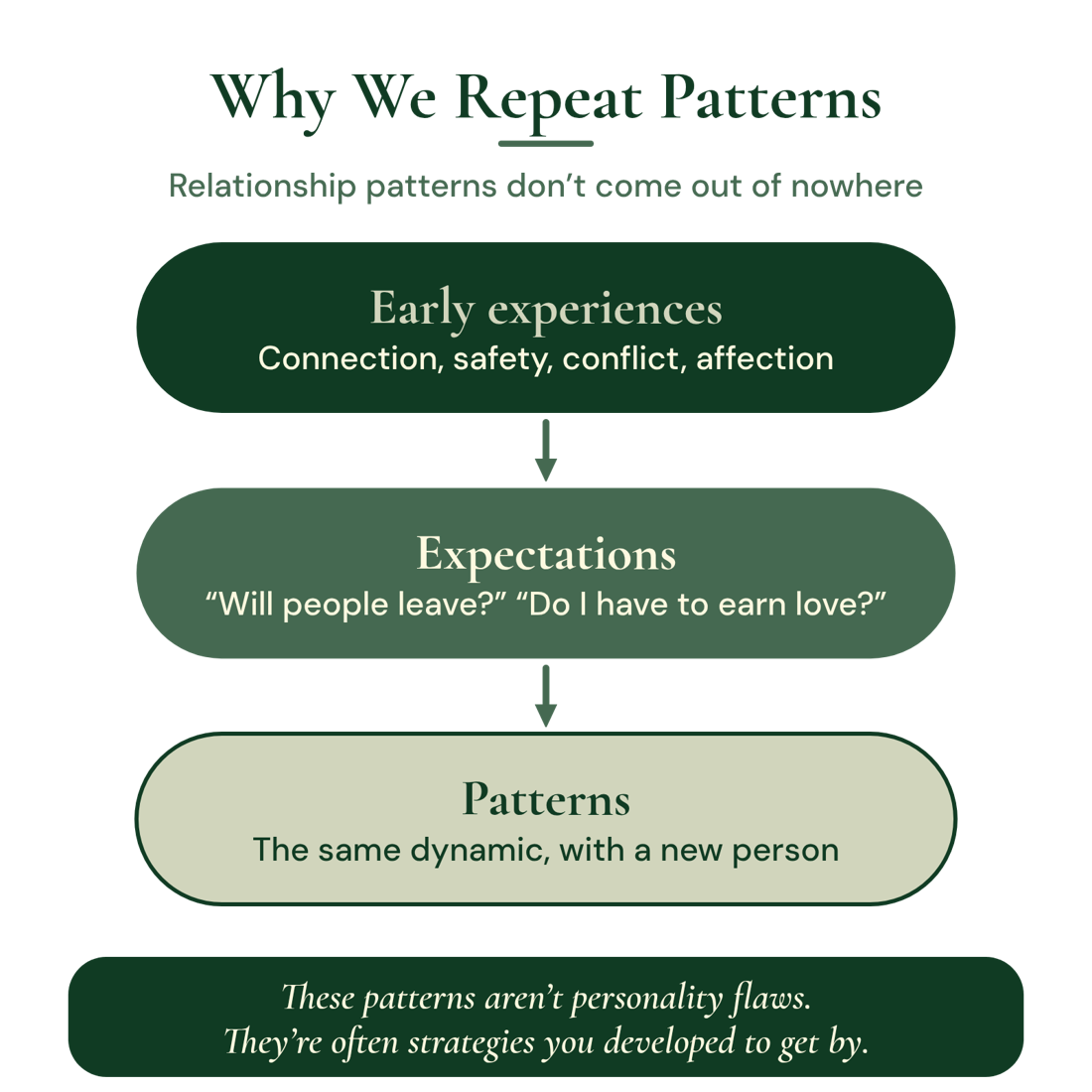
“Never again.” Then a few years later realized you're somehow experiencing the same dynamic with a completely different person? It's frustrating. But relationship patterns don't come out of nowhere. We learn about relationships through our earliest experiences of connection, safety, conflict, affection, boundaries, communication, and emotional availability.
Over time, we develop expectations about things like:
Can I trust people? Will people leave? What happens when I need something? Is conflict dangerous? Do I have to earn love? Am I responsible for other people's feelings? What happens if someone is disappointed in me? These patterns aren't permanent personality flaws. They're often strategies you developed for navigating relationships.
Therapy can help you notice them, understand where they came from, and decide whether they're still working for you.
Tell us a little about what’s going on and we’ll suggest the therapist who fits.
Attachment refers to the ways we learn to seek connection, respond to closeness, and manage perceived threats within important relationships. You may have heard terms like secure, anxious, avoidant, or disorganized attachment. These can be useful frameworks for understanding patterns—but they're not personality tests or permanent labels.
For example, you might notice that when someone becomes distant, you immediately want to get closer. You text more. Analyze more. Ask what's wrong. Look for reassurance. Or maybe closeness itself makes you uncomfortable. When someone needs more from you, you pull away. Shut down. Become irritated. Convince yourself you don't really need the relationship anyway.
And sometimes two people's patterns trigger each other. One person pursues. The other withdraws. The withdrawal makes the first person more anxious. The anxiety makes the other person withdraw further. Suddenly you're both stuck in a cycle neither of you actually wants. Therapy can help you recognize the cycle instead of automatically blaming yourself or the other person.
Dating can be fun. It can also make you want to throw your phone into Lake Ontario. Apps. Ghosting. Situationships. Mixed signals. Talking stages. Trying to figure out whether someone actually likes you without appearing too interested in whether they actually like you. Wondering when to text. Whether you're texting too much. Whether you're settling.
Whether you're being too picky. Whether that thing they said is a red flag or you're overthinking it. And somehow you're supposed to remain completely emotionally regulated throughout the entire experience. Dating can bring up rejection, insecurity, attachment, body image, self-esteem, loneliness, vulnerability, and fear of getting hurt.
Therapy isn't about teaching you how to “win” at dating. It's about helping you date without completely abandoning yourself in the process.
Sometimes dating turns your brain into a full-time detective. They took longer to reply. Are they losing interest? Their message had a different tone. Did I do something? They haven't made plans yet. Should I ask? Would that seem needy? They viewed your story but didn't respond. Now you're analyzing evidence like you're preparing a court case.
Dating naturally involves uncertainty. And uncertainty can be particularly difficult if you struggle with anxiety, rejection sensitivity, previous relationship trauma, or anxious attachment. Therapy can help you learn how to tolerate uncertainty without letting every change in someone's texting habits determine how you feel about yourself.
Sometimes you can recognize a pattern but have no idea how to stop repeating it.
Maybe you're consistently drawn to people who are:
Or maybe you're attracted to the feeling of uncertainty itself. The highs feel incredibly high. The lows feel terrible. And a calm, consistent relationship almost feels…boring. Therapy can help you explore what feels familiar in relationships, what you interpret as chemistry, and what you've learned to expect from closeness.
The goal isn't to give you a checklist for finding the perfect person. It's helping you become better at recognizing what actually feels safe, reciprocal, respectful, and compatible with the life you want.
Breakups can hurt far more than people sometimes acknowledge. You're not only losing a person. You're losing routines. Inside jokes. Physical affection. Friendships. Plans. A future you had already started imagining. Maybe you initiated the breakup and you're still devastated. Maybe they ended it and you didn't see it coming. Maybe you know the relationship wasn't healthy and still desperately miss them.
Maybe you're trying not to text them. Maybe you're checking their social media. Maybe you're replaying every conversation trying to figure out exactly where things changed. Or maybe you're grieving someone who seems to have moved on while you're still trying to understand what happened.
Therapy can help you process the loss without turning the entire relationship into either:
“They were perfect and I'll never find anyone again.” or “They were terrible and none of it mattered.” Relationships can matter deeply and still need to end.
Romantic relationships get a lot of attention. Friendship heartbreak often doesn't. But losing a close friend can be devastating. Maybe you've grown apart. There was a betrayal. The friendship became one-sided. Your lives changed. Someone stopped putting in effort. Or there wasn't even a dramatic ending. You just slowly stopped being part of each other's lives.
Friendships can also become complicated when you're always the therapist friend, feel excluded from a group, struggle to make friends as an adult, or realize that a friendship you've had for years no longer feels healthy. You are allowed to grieve friendship loss. And you're allowed to want healthier friendships without needing the other person to be a terrible human being first.
Family relationships can be some of the most complicated relationships we have. Because there is history. Maybe your relationship with a parent is loving but difficult. Maybe your sibling relationship is strained. Maybe your family doesn't respect your boundaries. Maybe everyone expects you to be the responsible one. The easygoing one.
The successful one. The mediator. The one who doesn't cause problems. Maybe you've spent years keeping the peace and are starting to realize that the peace has mostly been maintained at your expense. Therapy can help you navigate family relationships without automatically telling you to cut people off or simply “accept them because they're family.”
Sometimes the work is improving communication. Sometimes it's adjusting expectations. Sometimes it's grieving the relationship you wish you had. Sometimes it's setting boundaries. And sometimes it's figuring out what level of relationship feels healthiest for you.
If saying no makes you feel like you've committed a crime, we should probably talk about boundaries. People-pleasing often looks kind from the outside. You're helpful. Flexible. Reliable. Easygoing.
But underneath it may be:
I don't want them to be mad at me. I don't want to disappoint anyone. I don't want them to think I'm selfish. It's easier if I just do it myself. So you say yes. Then feel resentful. Then feel guilty for being resentful. Then say yes again. Boundaries aren't about controlling other people's behaviour. They're about becoming clearer about what you're willing to participate in, what you need, and what you'll do when those limits aren't respected.
Therapy can help you learn to tolerate something that can feel terrifying at first:
Other people being disappointed with you.

Sometimes you're trying to decide what kind of relationship you can realistically have with a family member. Maybe you've reduced contact. Maybe you're considering taking space. Maybe you're estranged. Maybe you're trying to reconnect. Or maybe you have a relationship with someone who repeatedly hurts you, but the idea of stepping away brings enormous guilt.
These situations rarely have simple answers. Therapy shouldn't automatically push you toward reconciliation or estrangement. Instead, it can help you explore the history, your safety and well-being, what you've already tried, your boundaries, your hopes for the relationship, and what choices are available to you. Ultimately, you decide what relationship you want to have.
A lot of relationship problems get described as:
“We have communication issues.” Sometimes that's true. But often the problem isn't that you don't know the correct words. It's what happens emotionally when the conversation gets difficult. You feel criticized and immediately defend yourself. You feel ignored and become louder. You sense conflict and shut down. You don't say anything because you're afraid they'll leave.
You agree just to end the conversation. Then you're resentful three days later. Therapy can help you understand what happens underneath your communication patterns so you're not simply memorizing scripts while repeating the same emotional cycle.
Trust can be damaged in many ways. Infidelity. Lying. Broken promises. Financial secrecy. Repeated boundary violations. Sharing private information. Emotional betrayal. Or years of smaller experiences that slowly make you stop feeling safe with someone. After betrayal, you might find yourself constantly checking. Questioning. Replaying what happened.
Wondering what else you don't know.
You may desperately want to trust again while another part of you is thinking:
“Absolutely not. We're never getting blindsided like that again.” Therapy can help you process betrayal, understand what you need moving forward, and decide what rebuilding trust—or moving on—looks like for you.
You can have relationships and still feel incredibly lonely. Maybe you're surrounded by people but don't feel truly known by any of them. Maybe you've moved. Your friendships changed. Everyone got busy. You work from home. You're single when most of your friends are partnered. Or making friends as an adult has somehow become significantly harder than anyone warned you about.
Sometimes loneliness isn't about needing more people. It's about needing more meaningful connection. Therapy can help you explore what's getting in the way of connection and what kind of relationships you're actually looking for.
A free 15-minute consultation is the easiest first step. Book online in a minute, or give us a call.
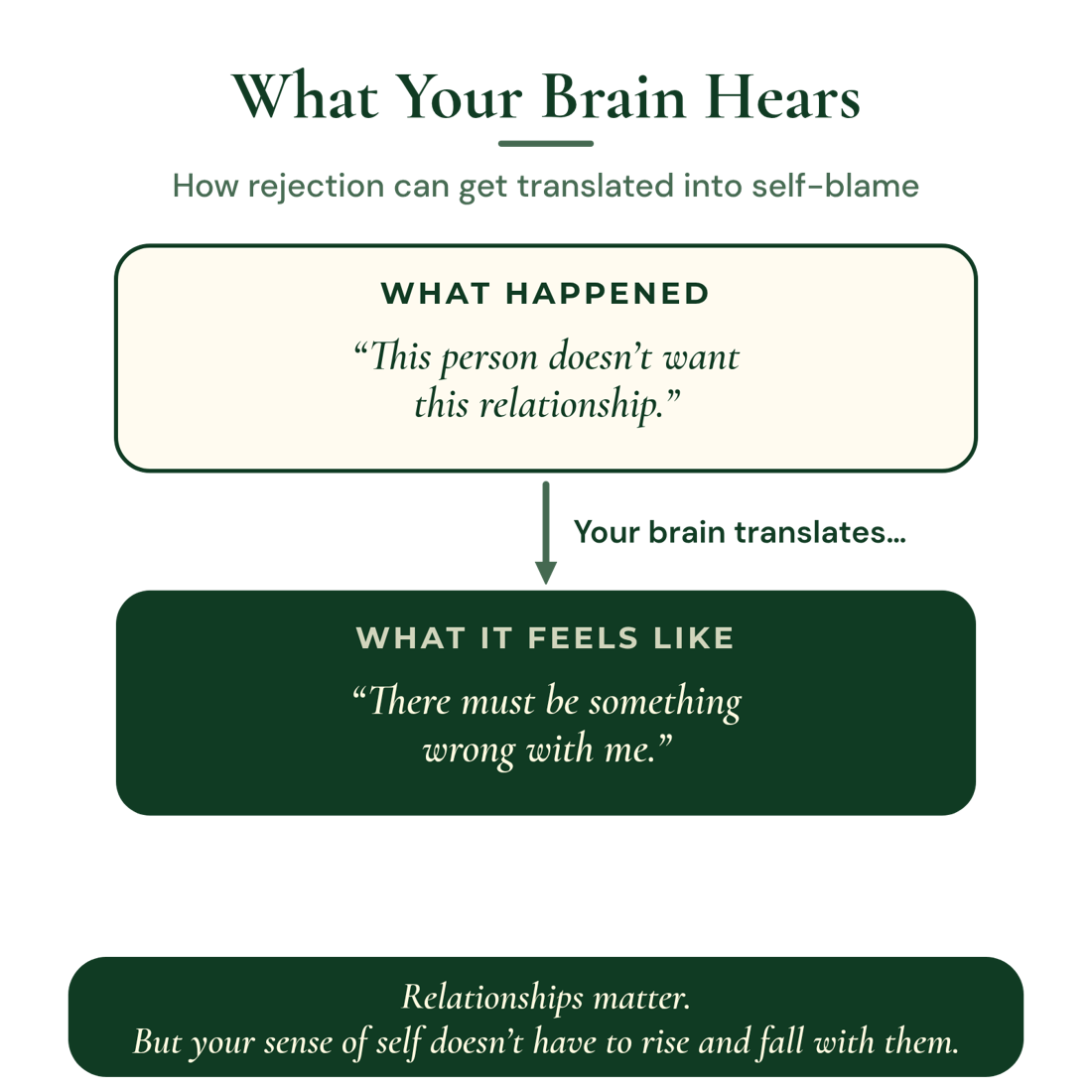
Sometimes your relationship with yourself changes depending on how other people respond to you. Someone likes you? You feel good. Someone pulls away? Suddenly you're questioning everything. Someone criticizes you? You're replaying it for three days. Someone rejects you?
Your brain translates:
“This person doesn't want this relationship”
into:
“There must be something wrong with me.” Therapy can help you build a sense of self that doesn't completely rise and fall based on someone else's attention, approval, affection, or availability. Because relationships matter. But you still need to exist inside them.
Individual therapy can be incredibly useful for relationship concerns—even if the other person never attends a session.
Depending on what you're experiencing, therapy may help you:
Sometimes relationship therapy is about changing how you interact with someone else. Sometimes it's realizing that you can't change someone else and figuring out what you want to do with that information. Both can be powerful.
Relationships are emotional. So simply understanding intellectually what you “should” do often isn't enough. You might know you shouldn't text your ex. Your thumb apparently did not receive that information. You might know you're allowed to set a boundary. Then someone gets upset and suddenly you're apologizing for having one.
Our therapists draw from approaches including Emotion-Focused Therapy (EFT), attachment-based therapy, Acceptance and Commitment Therapy (ACT), Dialectical Behaviour Therapy (DBT), Cognitive Behavioural Therapy (CBT), narrative therapy, psychodynamic approaches, solution-focused therapy, and person-centred therapy.
Depending on your needs, we might look at:
What's happening right now? and Where did this pattern come from? We can work on practical communication and boundaries while also understanding the deeper attachment, emotional, and relational patterns underneath them. Because sometimes knowing what to say is helpful. And sometimes you need to understand why saying it feels so terrifying.
Relationships are messy. Therapy can make room for messy.
You can tell us:
“I know they're bad for me and I still miss them.” “I checked their Instagram again.” “I said I wasn't going to text them. I texted them.” “My mom called and somehow I'm furious for the next six hours.” “I know I'm people-pleasing while I'm doing it and I still can't stop.” “I genuinely cannot tell whether this is a red flag or whether TikTok has ruined my brain.”
We're not going to shame you. At Heart of Oak Psychotherapy, therapy is collaborative, warm, and human. You can laugh. Cry. Swear. Tell us the entire dating-app saga. Show us the text you're overthinking. Admit you're considering going back to someone everyone in your life hates. Or spend half the session trying to understand why one comment from your dad bothered you so much.
Relationships affect us deeply. You're allowed to talk about them like they do.
We provide in-person relationship and dating therapy in Oakville, Ontario for teens and adults navigating romantic relationships, dating, breakups, friendships, family conflict, attachment, boundaries, people-pleasing, loneliness, trust, communication, and difficult relationship patterns. You don't need the other person to attend therapy.
Individual relationship therapy focuses on helping you understand your experiences, patterns, needs, boundaries, and choices. If you're specifically looking to attend therapy together with a romantic partner, our Couples Therapy services may be a better fit.
We also provide online relationship and dating therapy throughout Ontario and select provinces and territories. Virtual therapy can give you a private place to work through relationship concerns from home without adding travel time to an already busy schedule. Whether you're trying to understand a romantic relationship, survive modern dating, process a breakup, navigate a friendship, set boundaries with family, or figure out why the same relationship pattern keeps following you around, you don't have to untangle it alone.
Whether you're looking for relationship therapy in Oakville or online relationship counselling elsewhere in Ontario, we'll help you find a therapist whose experience, personality, approach, and availability fit what you're looking for.
Book a free 15-minute consultation with any of us, or let us suggest who fits. Meet the whole team →
Individual therapy
Can’t find your answer? Call (289) 201-1951 or email hello@heartofoakpsychotherapy.com.
Absolutely. Individual therapy can help you understand your relationship patterns, communication, attachment, boundaries, emotions, and what you want from the relationship. Your partner doesn't need to participate.
On this page, relationship therapy refers primarily to individual psychotherapy focused on the relationships in your life. That might include romantic relationships, dating, friendships, family relationships, breakups, or other interpersonal concerns. Couples therapy involves partners attending therapy together and working directly on their relationship.
Heart of Oak Psychotherapy offers both.
Yes. Therapy can help with dating anxiety, rejection, confidence, attachment patterns, boundaries, communication, repeated relationship patterns, and figuring out what you're actually looking for in a relationship. We cannot guarantee that the apps will become less chaotic. But we can help them take up less space in your head.
Yes. Breakups can involve significant grief, identity changes, loneliness, anger, rejection, and uncertainty about the future. Therapy can give you space to process the relationship and loss while helping you rebuild your life outside of it.
Absolutely. Friendships are important relationships. Conflict, betrayal, exclusion, loneliness, friendship breakups, changing friendships, or difficulty making and maintaining friendships are all appropriate things to bring to therapy.
Yes. Individual therapy can help you understand family dynamics, develop boundaries, improve communication, process difficult experiences, adjust expectations, and decide what kind of relationship you want with family members.
Therapy isn't about having someone else make your relationship decisions for you. Your therapist can help you examine patterns, clarify your needs and values, explore concerns, recognize unhealthy dynamics, and consider your options. But decisions about whether to stay, leave, reconcile, date someone, end a friendship, or change a family relationship remain yours.
If there are concerns related to abuse or safety, your therapist can also help you think through appropriate supports and safety considerations.
There can be many reasons certain relationship dynamics feel particularly familiar or compelling. Attachment experiences, self-esteem, previous relationships, family dynamics, beliefs about love, and what you've learned to interpret as chemistry can all play a role. Therapy can help you understand your individual pattern rather than assuming there's one explanation that applies to everyone.
Yes. The tricky part about boundaries often isn't knowing what boundary you want. It's tolerating how you feel after you set it. Therapy can help you understand guilt, fear of disappointing people, people-pleasing, and the relationship patterns that make boundaries difficult.
Finding the right fit matters more than finding the perfect words. Answer two quick questions and book a free consultation; we’ll point you to the therapist who suits what you’re looking for.
Who works with what, at a glance.
| Couples | Michaela, Megan |
| Preteens | Mairin, Michaela |
| Teens | Mairin, Michaela, Megan (16+), Katarina |
| Families & parenting | Michaela, Megan, Katarina |
| OCD & intrusive thoughts | Mairin, Megan (ERP: Mairin) |
| Eating disorders & body image | Megan, Katarina |
| Trauma & PTSD | Mairin, Megan, Katarina |
| ADHD & neurodivergence | Mairin, Michaela, Megan |
| Men’s mental health | Mairin (a particular focus), Michaela, Megan, Katarina |
| First responders & healthcare workers | Mairin, Megan, Katarina |
| Anxiety, stress & self-esteem | All four of us |
Not on the list? Ask us in your free consultation.
Healthy relationships aren't relationships where nobody ever gets hurt, annoyed, disappointed, or misunderstood. They're relationships where there's room for two whole people. You can care about someone without being responsible for every emotion they have. You can love someone and set a boundary. You can miss someone and know you shouldn't go back.
You can outgrow a friendship. You can want a relationship without accepting one that doesn't meet your needs. You can disappoint your family and still be a good person. You can be single without being behind. And you can have a relationship without disappearing inside of it. Maybe the goal isn't becoming perfect at relationships.
Maybe it's understanding yourself well enough that you can choose relationships from a place of connection rather than fear.
Not sure which therapist is right for you?
Dating is already giving you enough decisions to make. We'll make this one easier. Submit our Intake Form or book a free 15-minute matching call with Katarina Jurriaans. She'll learn a little about what's happening in your relationships, what you're hoping to work on, and what kind of therapist you'd connect with, then help match you based on areas of focus, approach, personality, and availability.
Book your free consultation. Let's make your relationships feel a little less complicated—and help you feel more like yourself inside them.
Many people come in for one thing and find it’s connected to another. Explore the other areas our therapists work with.
Most people aren’t. Book a free 15-minute consultation and we’ll help you sort out where to start.
Book a free 15-minute matching call →