
Mairin
Registered Psychotherapist (Qualifying)
Sees: Preteens, teens, adults, and first responders & healthcare workers

Therapy where you don't have to explain or defend who you are





Tell us a little about what’s going on and we’ll suggest the therapist who fits.
We’ll match you →Maybe being LGBTQIA+ is exactly what you want to talk about. Or maybe it has absolutely nothing to do with why you're looking for therapy. Maybe you're here because you're anxious. Burned out. Going through a breakup. Struggling with your family. Questioning your identity. Dealing with an eating disorder. Trying to figure out dating.
Feeling depressed. Overwhelmed at work. Or simply going through a rough season of life. And you want to know that when you mention your partner, your sexuality, your gender, your pronouns, or your family structure, your therapist isn't going to make it weird. We provide LGBTQIA+ affirming therapy in Oakville and online across Ontario and select provinces and territories for teens and adults.
Whether you want to explore your identity or simply want a therapist who understands that your identity is one part of a much bigger person, you are welcome here. You don't have to educate us before we can support you.
LGBTQIA+ affirming therapy is psychotherapy that respects and supports diverse sexual orientations, gender identities, gender expressions, relationships, and lived experiences. Being lesbian, gay, bisexual, transgender, queer, questioning, intersex, asexual, Two-Spirit, or another diverse sexual or gender identity is not a mental illness and isn't something therapy needs to “fix.”
Affirming therapy recognizes something important:
Your identity isn't inherently the problem. But navigating a world where LGBTQIA+ people may experience stigma, discrimination, rejection, misunderstanding, pressure to hide parts of themselves, or uncertainty about whether it's safe to be open can affect mental health. At the same time, not every problem an LGBTQIA+ person experiences has anything to do with being LGBTQIA+.
Sometimes anxiety is anxiety. A breakup is a breakup. Work is stressful. Your family is driving you nuts. And your therapist should be able to support the whole picture.
Maybe you know exactly who you are. Maybe you've known since you were twelve.
Or maybe you're thinking:
“I genuinely have no idea.” You might be questioning your sexuality. Your gender. How you want to identify. Whether you want a label at all.
You may wonder:
“Am I actually attracted to them?” “What does this mean about me?” “Do I have to come out?” “What if my identity changes?” “Am I queer enough to use this label?” “What if I'm wrong?” Therapy doesn't need to push you toward a particular identity. An affirming therapist can give you space to explore what you're experiencing without deciding the answer for you.
You're allowed to question. You're allowed to take your time. You're allowed to change the language you use. And you're allowed to decide that a label isn't particularly important to you at all.
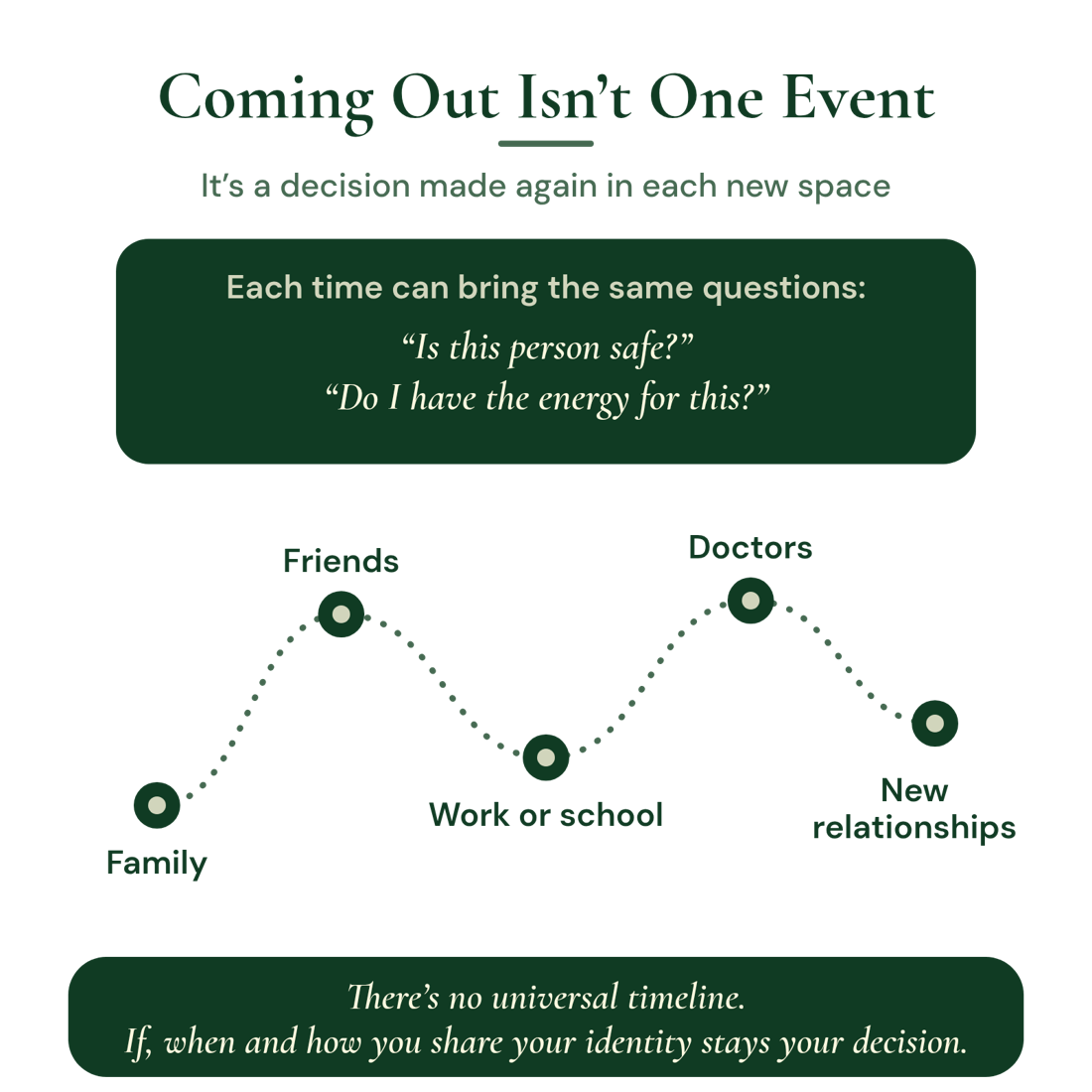
Coming out is often talked about like it's one big event. For many LGBTQIA+ people, it's actually a decision that happens over and over again. Family. Friends. Coworkers. School. Doctors. New jobs. New relationships. New social situations.
Each situation can involve another calculation:
Is this person safe? Do I want them to know? Will this change how they see me? Do I have the energy for this conversation? You may desperately want to tell someone and feel terrified of their reaction. Or you may feel pressure to come out when you aren't ready—or don't want to. There is no universal timeline. Therapy can help you think through your relationships, safety, values, hopes, fears, and possible outcomes.
The decision about if, when, and how you disclose your identity remains yours.
Tell us a little about what’s going on and we’ll suggest the therapist who fits.
Family reactions to LGBTQIA+ identities can range from deeply supportive to confusing, dismissive, controlling, or rejecting. Sometimes the response is obvious. Other times it's more subtle. A parent says they love you, but refuses to acknowledge your relationship. Someone uses your name but not consistently. Family members avoid talking about your identity.
You're told:
“We accept you, we just don't understand why you have to talk about it.” Or perhaps your family is genuinely trying, but you're exhausted from having to teach them everything. You may love your family and still feel deeply hurt by them. You may want a relationship with them and need boundaries. You may be grieving the acceptance you hoped you'd receive.
Therapy can make room for that complexity without automatically telling you what your relationship with your family should look like.
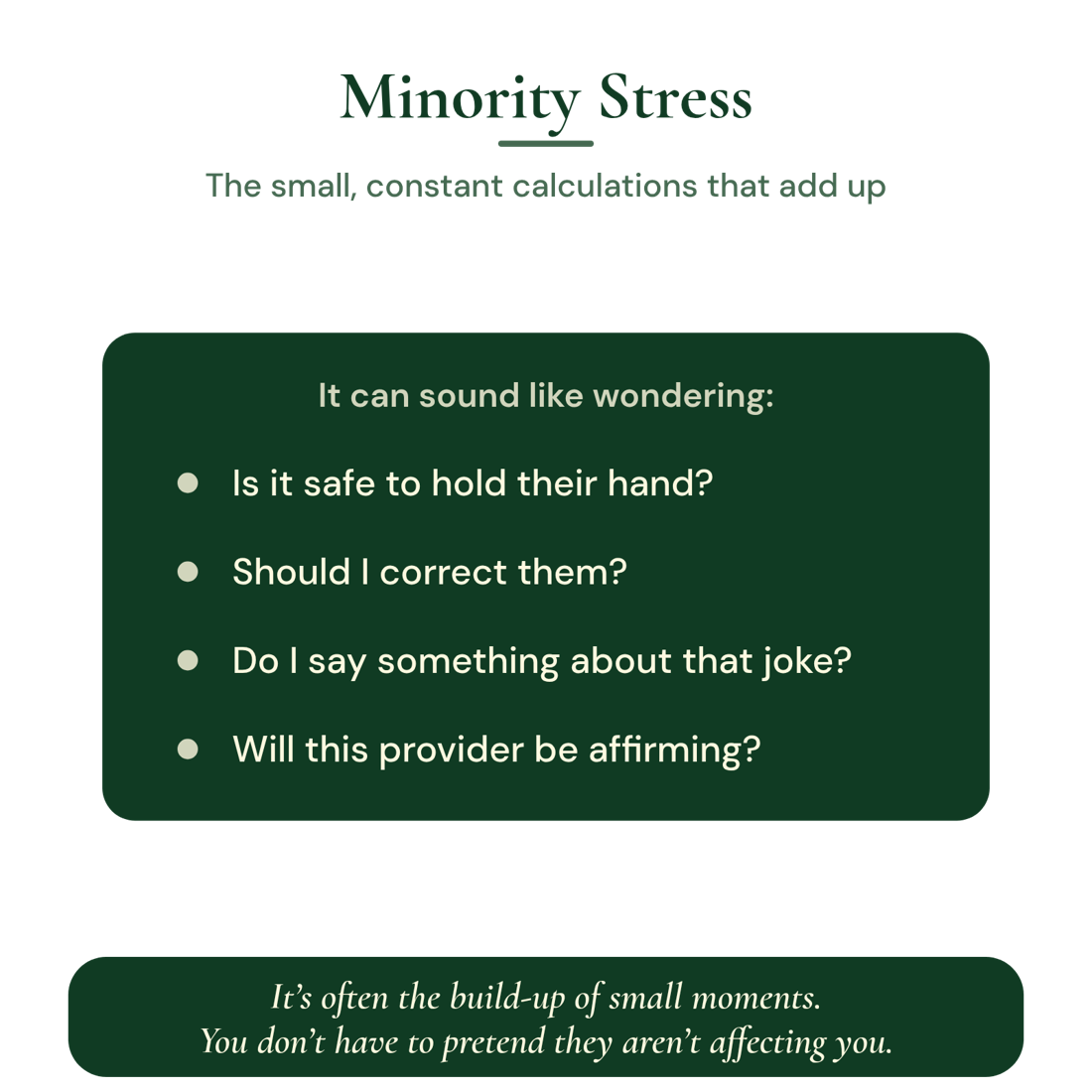
Sometimes the difficult part isn't one major event. It's the accumulation of smaller experiences. Wondering whether it's safe to hold your partner's hand. Deciding whether to correct someone. Hearing a joke and wondering whether it's worth saying something. Being the only LGBTQIA+ person in a room. Watching public conversations debate identities that are deeply personal to you.
Wondering whether a healthcare provider will be affirming. Trying to figure out whether someone's reaction was actually discriminatory or whether you're overthinking it. This ongoing stress can take a toll. The concept of minority stress helps describe the additional stress people from stigmatized groups may experience because of prejudice, discrimination, expectations of rejection, concealment, and internalized stigma.
Therapy can't remove every external stressor. But it can give you somewhere you don't have to pretend those experiences aren't affecting you.
Sometimes the harshest messages don't stay outside of us. They become our own thoughts. Maybe you grew up hearing that being LGBTQIA+ was wrong, embarrassing, disappointing, inappropriate, sinful, strange, or something that happened to “other people.” Even if you intellectually reject those messages now, emotionally they may still show up.
You might notice:
Therapy can help you separate what you actually believe about yourself from what you were taught to believe.
Gender can be deeply personal. You may feel confident in your gender identity. You may be questioning. You may be exploring a different name, pronouns, clothing, presentation, or way of expressing yourself. You may be considering social or medical transition. Or you may not want to transition at all. Gender exploration doesn't need to have a predetermined destination.
Therapy can provide space to explore your experiences, emotions, relationships, body image, family dynamics, social concerns, and hopes for the future. An affirming therapist isn't there to decide your identity for you. We're there to help you explore your own experience of yourself.
Dating can already be complicated. LGBTQIA+ dating can sometimes add another layer.
You might be navigating:
You may also be learning how to have relationships without having many examples of relationships like yours growing up. Therapy can help you explore relationship patterns without assuming that every relationship needs to fit one particular model.
Your first LGBTQIA+ relationship might happen at fifteen. Or twenty-five. Or fifty-five. There isn't a deadline. Sometimes a first queer relationship brings an unexpected amount of emotion. Excitement. Relief. Fear. Grief for experiences you didn't have earlier. Questions about identity. Or the realization that you're learning relationship skills you assumed everyone else figured out years ago.
You aren't behind. You're experiencing something new. Therapy can give you somewhere to process all of it without treating your relationship like a novelty.
Breakups hurt regardless of sexual orientation or gender identity. But sometimes an LGBTQIA+ breakup can involve additional losses. You might lose mutual friends. Community. Connection to a chosen family. A sense of belonging. Or the person who first made you feel completely understood in your identity.
If your dating pool already feels small, a breakup can also trigger thoughts like:
“What if I never find someone again?” Therapy can help you grieve the relationship without treating your heartbreak as any less significant than anyone else's.

Finding people who understand you can be incredibly important. But LGBTQIA+ community isn't automatically easy for everyone. Maybe you don't feel “queer enough.” You don't fit the stereotype people expect. You live somewhere with fewer LGBTQIA+ spaces. You feel awkward entering community spaces alone. Or you simply haven't found your people yet.
You may also have friendships that became your chosen family and carry enormous emotional importance. Therapy can help you explore loneliness, belonging, friendship, rejection, and what meaningful community looks like for you.
Being LGBTQIA+ doesn't mean every mental health concern is related to your identity.
Our therapists can support LGBTQIA+ clients experiencing concerns including:
Sometimes identity is central to the work. Sometimes it's one piece. Sometimes it's barely relevant. You get to decide what we're talking about.
Body image can be particularly complicated when gender, sexuality, belonging, attraction, and identity intersect. You may struggle with how your body looks. How it's perceived by others. Whether it feels aligned with your gender. Whether you're attractive enough within a particular community. Or whether changing your body feels like the price of belonging.
LGBTQIA+ people can also experience eating disorders and disordered eating, and those experiences deserve care that doesn't make assumptions about gender, bodies, or identity. Therapy can help you explore your relationship with your body while respecting the complexity of what your body means to you.
Some LGBTQIA+ people have experienced bullying, rejection, harassment, discrimination, relationship abuse, sexual violence, religious trauma, family conflict, or other difficult experiences. Others haven't. We won't assume trauma simply because you're LGBTQIA+. But if difficult experiences are part of your story, therapy can provide space to process them without minimizing the role identity, stigma, relationships, or community may have played.
You decide what parts of your story we explore and when.
A free 15-minute consultation is the easiest first step. Book online in a minute, or give us a call.
Therapy isn't about changing who you are. It's about helping you build a life where you can be more fully yourself.
Depending on what you're experiencing, therapy may help you:
And sometimes therapy has very little to do with LGBTQIA+ identity. Sometimes you need to complain about your boss for fifty minutes. That's allowed too.
There isn't one therapy approach specifically for LGBTQIA+ people. You're an individual first. Your therapy will depend on what you want help with. We may explore relationships. Identity. Anxiety. Family. Attachment. Self-esteem. Trauma. Dating. Body image. Or something entirely unrelated. Our role isn't to tell you who you are or who you should become.
It's to help you understand yourself, navigate what's difficult, and make choices that fit your life and values.
You shouldn't have to spend the first three sessions figuring out whether your therapist is safe to be yourself around. We want therapy to feel warm, affirming, collaborative, and genuinely human. You can tell us you're questioning. You can tell us you're completely certain. You can change the label you use. You can tell us about your partner without wondering whether we're silently judging your relationship.
You can correct us. You can swear. You can laugh. You can talk about sex and dating. You can complain about your family.
You can say:
“I don't actually want to talk about being queer today. My coworker is driving me insane.” Perfect. You are not a walking identity category. You're a whole person. Therapy should treat you like one.
We provide LGBTQIA+ affirming therapy in Oakville, Ontario for teens and adults seeking supportive, inclusive mental health care. Our therapists can support concerns related to sexuality, gender identity, coming out, relationships, family, belonging, discrimination, body image, self-esteem, and identity exploration, as well as anxiety, depression, ADHD, OCD, eating disorders, trauma, grief, stress, and other mental health concerns.
Whether your LGBTQIA+ identity is the main reason you're coming to therapy or simply something you want your therapist to understand and respect, you're welcome here.
We also provide online LGBTQIA+ affirming therapy throughout Ontario and select provinces and territories. Virtual therapy can be especially valuable if you live somewhere with fewer affirming mental health resources, don't want to travel for appointments, or simply feel more comfortable talking from your own space. You can access therapy from home while working with someone who respects your identity, relationships, and experiences.
Whether you're looking for LGBTQIA+ affirming therapy in Oakville or online LGBTQIA+ therapy elsewhere in Ontario, we'll help you find a therapist whose experience, personality, therapeutic approach, and availability fit what you're looking for.
Book a free 15-minute consultation with any of us, or let us suggest who fits. Meet the whole team →
Individual therapy
Can’t find your answer? Call (289) 201-1951 or email hello@heartofoakpsychotherapy.com.
No. “LGBTQIA+ affirming” simply describes an approach to therapy that respects diverse sexual orientations and gender identities. Our therapists work with clients across identities and backgrounds.
Absolutely not. Questioning and exploring are welcome. You don't need to choose a label, and therapy shouldn't pressure you toward a particular identity. You can take your time understanding what feels right for you.
No. Your therapist isn't there to assign you an identity. Therapy can help you explore your feelings, experiences, questions, relationships, and values while leaving space for you to determine what language—if any—fits.
Yes. You don't need to be out to family, friends, work, school, or anyone else to access affirming therapy. Your therapist can also help you think through questions about disclosure without pressuring you to come out.
Therapy can help you explore whether you want to come out, what you're hoping for, what you're afraid of, possible reactions, boundaries, support systems, and safety considerations. The goal isn't to convince you to come out. The decision remains yours.
Family rejection or lack of acceptance can be deeply painful. Therapy can help you process those experiences, establish boundaries, develop support systems, grieve the relationship you hoped for, and consider what kind of relationship with family feels healthiest for you.
Yes. Therapy can provide LGBTQIA+ teens with a confidential, supportive space to work through mental health concerns, identity questions, relationships, school, family, or whatever else is important to them. Parent or caregiver involvement will depend on the young person's age, circumstances, clinical needs, consent and confidentiality considerations.
Yes. Dating, relationships, attraction, intimacy, identity, breakups, communication, and sexual concerns can all be appropriate topics for therapy. You don't need to censor your relationships to make your therapist comfortable.
Then it doesn't have to be what we focus on. You might want help with anxiety, ADHD, grief, an eating disorder, burnout, work, relationships, depression, or something else entirely. Affirming therapy means your identity will be respected. It doesn't mean every conversation needs to revolve around it.
Finding the right fit matters more than finding the perfect words. Answer two quick questions and book a free consultation; we’ll point you to the therapist who suits what you’re looking for.
Who works with what, at a glance.
| Couples | Michaela, Megan |
| Preteens | Mairin, Michaela |
| Teens | Mairin, Michaela, Megan (16+), Katarina |
| Families & parenting | Michaela, Megan, Katarina |
| OCD & intrusive thoughts | Mairin, Megan (ERP: Mairin) |
| Eating disorders & body image | Megan, Katarina |
| Trauma & PTSD | Mairin, Megan, Katarina |
| ADHD & neurodivergence | Mairin, Michaela, Megan |
| Men’s mental health | Mairin (a particular focus), Michaela, Megan, Katarina |
| First responders & healthcare workers | Mairin, Megan, Katarina |
| Anxiety, stress & self-esteem | All four of us |
Not on the list? Ask us in your free consultation.
Maybe you're still figuring things out. Maybe you've known who you are for years. Maybe you've built an incredible community around you. Maybe you're still looking for one. Maybe you're proud of who you are. Maybe you're working on getting there. Or maybe your sexuality or gender is honestly one of the least interesting things about you and you'd really prefer to talk about literally anything else today.
All of that is welcome. You don't need to make yourself easier to understand. You don't need to have the perfect label. You don't need to justify your relationships. And you don't need to become someone else's version of who you're supposed to be. Therapy can be somewhere you get to bring all of yourself into the room.
Not sure which therapist is right for you?
Finding a therapist you actually feel comfortable with matters. Submit our Intake Form or book a free 15-minute matching call with Katarina Jurriaans. She’ll learn a little about what you're looking for in therapy, what's important to you in a therapist, and what you'd like support with, then help match you based on areas of focus, approach, personality, and availability.
Book your free consultation. Come as you are—we'll start from there.
Many people come in for one thing and find it’s connected to another. Explore the other areas our therapists work with.
Most people aren’t. Book a free 15-minute consultation and we’ll help you sort out where to start.
Book a free 15-minute matching call →