
Mairin
Registered Psychotherapist (Qualifying)
Sees: Preteens, teens, adults, and first responders & healthcare workers

You'd never talk to a friend the way you talk to yourself





Tell us a little about what’s going on and we’ll suggest the therapist who fits.
We’ll match you →You made one small mistake at work. Your brain has been replaying it since Tuesday. Someone gave you a compliment. You immediately explained why it wasn't true. You scroll through other people's lives and somehow everyone is thinner, richer, happier, further ahead, and better at being a person than you. You say yes when you want to say no.
You apologize when someone bumps into you. You rehearse what you're going to say before you order a coffee. And when something goes well? “I just got lucky.” When something goes badly? “Of course. That's so typical of me.” Maybe from the outside, you look confident. You're capable. Accomplished. Reliable. Funny, even.
But inside there's a voice that never seems to take a day off:
“Who do you think you are?” “You're not good enough.” “They're going to figure you out.” We provide therapy for self-esteem and confidence in Oakville and online across Ontario and select provinces and territories for preteens, teens, and adults struggling with a harsh inner critic, comparison, people-pleasing, perfectionism, imposter syndrome, body image, and the exhausting feeling of never being quite enough.
You don't need to love yourself before you start therapy. You just need to be a little tired of being so hard on yourself.
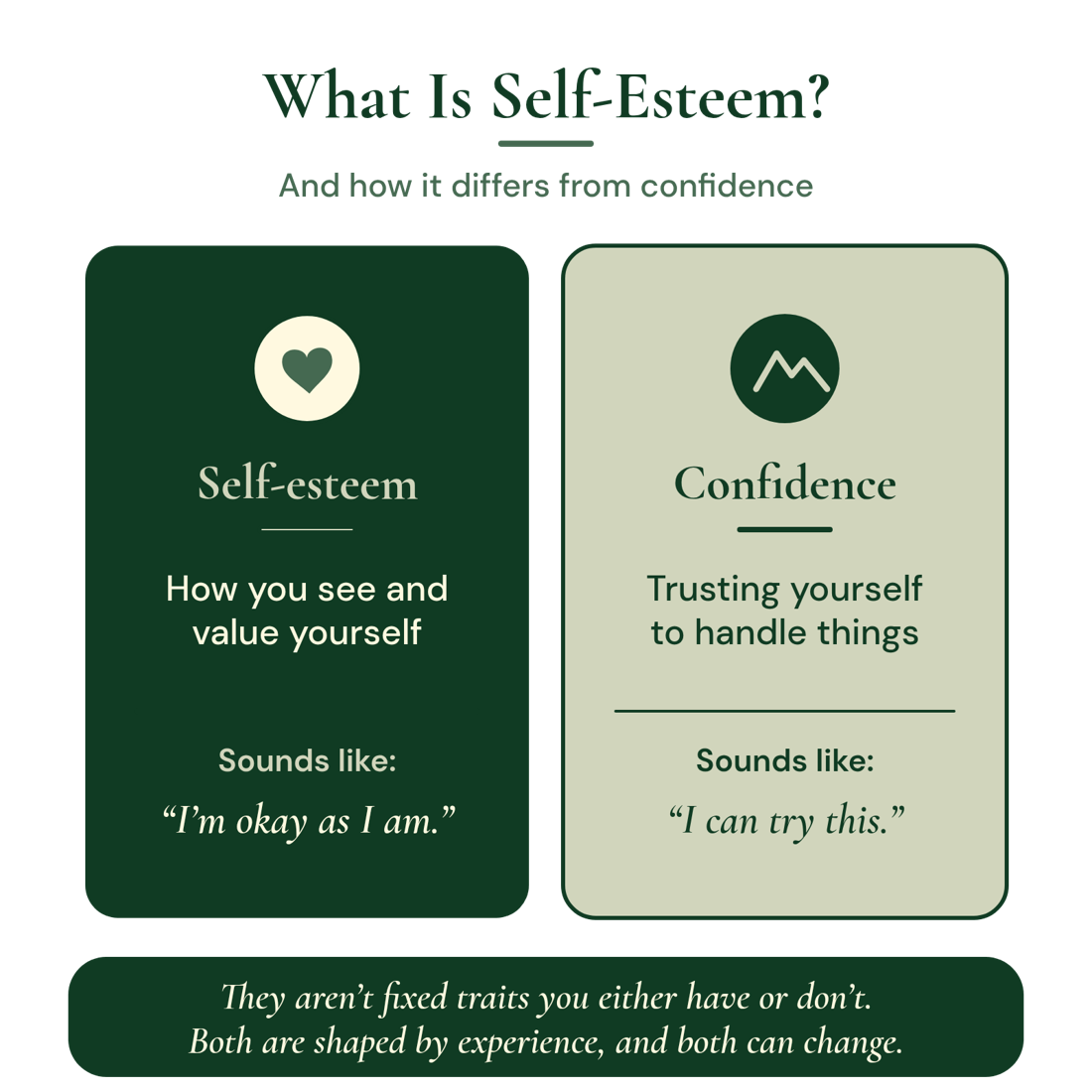
Self-esteem is how you see and value yourself. It's the general sense you carry around about whether you're worthy, capable, likeable, and okay as you are. Healthy self-esteem doesn't mean thinking you're perfect. Or better than everyone else. It means being able to see your strengths and your flaws and still believe you deserve respect, kindness, and a good life.
Confidence is related, but a little different. Confidence is more about trusting yourself to handle things. To try something new. To speak up. To make a decision. To recover if it doesn't go perfectly. You can be confident in some areas of your life and really struggle in others. Maybe you're a rock star at work and fall apart in relationships.
Or you feel great with friends and freeze in meetings. Self-esteem and confidence aren't fixed traits you either have or don't. They're shaped by your experiences, and they can change.
Low self-esteem doesn't always look like someone saying, “I hate myself.” Sometimes it's much quieter.
You might notice:
Sometimes low self-esteem looks like insecurity. Sometimes it looks like overachieving. And sometimes it looks like someone who seems totally fine but quietly believes they're one mistake away from everyone realizing they're not.
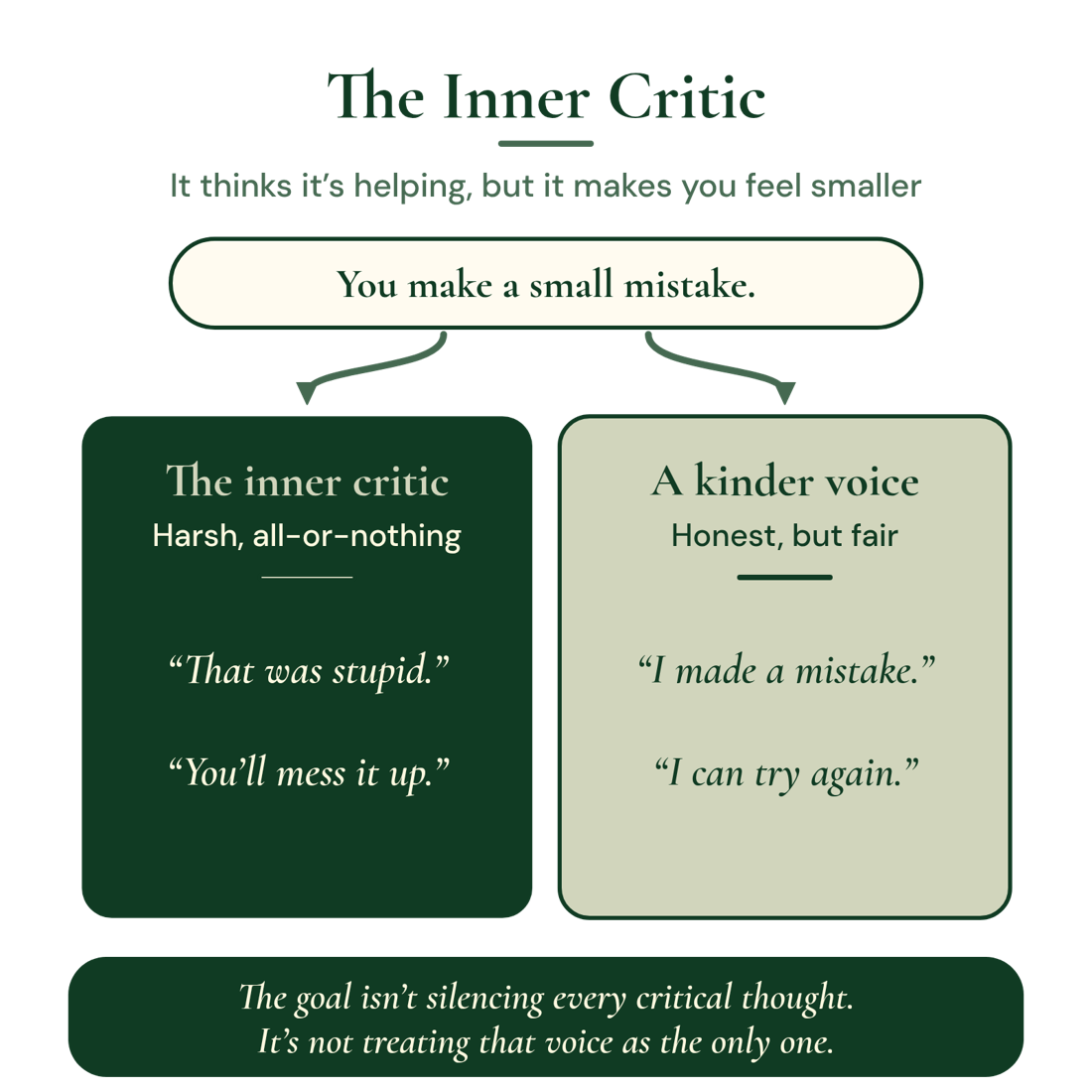
Most of us have an inner critic. For some people, it's a quiet voice in the background. For others, it's a full-time narrator with very strong opinions. “That was stupid.” “Why would you say that?” “Everyone thinks you're annoying.” “You should be further ahead by now.” “Don't even bother. You'll mess it up.” The inner critic often thinks it's helping.
It's trying to keep you safe from embarrassment, rejection, or failure. It thinks if it's hard enough on you, you'll never get caught off guard. The problem is that it doesn't actually make you feel safer. It makes you feel smaller. Therapy can help you notice your inner critic, understand where it came from, and learn how to respond to it differently.
The goal isn't to get rid of every self-critical thought. It's to stop treating that voice as the only one that gets a say.
Tell us a little about what’s going on and we’ll suggest the therapist who fits.
Comparison is human. But it's never been quite this easy. You open your phone and there it is. Someone's engagement. Someone's promotion. Someone's vacation. Someone's body. Someone's beautifully organized pantry. And there you are, eating crackers over the sink. You know social media isn't real life. You know everyone posts their highlights.
And yet somehow your brain still goes:
“Everyone has it together except me.” Comparison can also happen offline. Siblings. Classmates. Coworkers. Friends from high school. People your age who seem to have everything figured out. Therapy can help you notice when comparison is shaping how you feel about yourself and start measuring your life by what actually matters to you, not by someone else's timeline.
People-pleasing often looks like kindness. And often, it comes from a genuinely caring place. But underneath it, there may be fear. “What if they get upset with me?” “What if they think I'm selfish?” “It's easier if I just do it.” So you say yes. You agree. You go along with it. You shrink your needs so nobody else is inconvenienced.
And then you feel exhausted. Resentful. Invisible. Then guilty for feeling resentful. People-pleasing can be closely tied to self-esteem, because when your sense of worth depends on other people's approval, disappointing anyone can feel dangerous. Therapy can help you understand where people-pleasing comes from, practise setting boundaries, and learn to tolerate the discomfort of someone else not being happy with you.
Spoiler: you can survive it. And so can they.
Perfectionism isn't just having high standards. It's feeling like anything less than perfect is failure. And that failure says something about who you are. You might spend hours on something that was “good enough” two hours ago. Avoid starting things because you're worried you won't do them well. Feel crushed by small mistakes.
Struggle to celebrate wins because you're already focused on what's next. Or what you could have done better. “It's fine. But it could have been better.” Perfectionism can look like success from the outside. On the inside, it often feels like pressure, anxiety, and never being able to rest. Therapy can help you understand what perfectionism is protecting you from, loosen its grip, and build a sense of worth that isn't tied to flawless performance.
You can still care about doing well. You just don't have to earn your worth every single day.
You got the job. The promotion. The acceptance letter. The compliment from your boss. And instead of feeling proud, you feel like a fraud. “They made a mistake.” “I just got lucky.” “Any minute now, someone is going to figure out I don't know what I'm doing.” Imposter feelings are common, especially among people who are high-achieving, new to a role, or the first in their family or community to do something.
You may overprepare. Overwork. Avoid asking questions so no one realizes you don't already know the answer. Struggle to own your accomplishments. Therapy can help you look at the evidence a little more fairly, understand where imposter feelings come from, and begin to trust that you belong in the rooms you've worked hard to be in.
For many people, self-esteem and body image are deeply connected. How you feel about your body can affect how you feel about yourself in general. You might avoid photos. Skip events because you don't feel good in your clothes. Compare your body to everyone around you. Feel like you can't really start living until you look a certain way.
“I'll feel confident once I lose the weight.” “I'll date once I look better.” “I'll go to the beach when my body is ready.” Body image struggles can affect people of any age, gender, shape, or size. Therapy can help you explore where your beliefs about your body came from, reduce the amount of space body criticism takes up, and build a sense of worth that isn't tied to your appearance.
If body image concerns are connected to disordered eating, our Eating Disorders therapy may also be a helpful place to start.
Low self-esteem can show up in a big way at work or school. You might stay quiet in meetings, even when you have good ideas. Avoid applying for the promotion. Struggle to ask for what you deserve. Over-apologize in emails. Re-read a message seven times before sending it. Panic when your boss says, “Do you have a minute?” Or freeze during presentations even when you know the material.
For preteens and teens, it might look like not raising your hand, avoiding new activities, or deciding you're “just not smart” after one bad grade. Therapy can help you build confidence in how you show up, practise speaking up, manage self-doubt, and recognize the skills and value you already bring.

Self-esteem has a way of following us into our relationships. You might feel like you have to earn love. Constantly worry your partner or friends will leave. Struggle to say what you need. Stay in relationships that don't treat you well because part of you thinks you don't deserve better. Or keep people at arm's length so they don't get close enough to see the parts you're insecure about.
When your sense of worth rises and falls with other people's attention or approval, relationships can feel like an emotional rollercoaster. They text back quickly? Great day. They don't? “What did I do?” Therapy can help you build a sense of self that stays steadier, regardless of how other people respond to you. Because relationships matter.
But your worth shouldn't depend on them.
The preteen and teen years can be especially hard on self-esteem. Bodies are changing. Friendships are shifting. Social media is everywhere. Grades, sports, and appearances can start to feel like a ranking system.
Young people may start believing things like:
“I'm the ugly one.” “Everyone else is smarter than me.” “Nobody actually likes me.” Parents may notice their child pulling away, avoiding new things, getting really hard on themselves, or saying negative things about who they are. Therapy can give preteens and teens a supportive space to explore how they see themselves, build confidence, and develop kinder ways of talking to themselves that can carry into adulthood.
Self-compassion is the practice of treating yourself with the same kindness you'd offer someone you care about. That can feel strange at first. Some people worry that being kinder to themselves will make them lazy, unmotivated, or self-indulgent. “If I stop being hard on myself, I'll never get anything done.” But being cruel to yourself isn't the same as holding yourself accountable.
You can take responsibility for a mistake without deciding you're a terrible person. You can want to grow without believing you're broken. Self-compassion isn't about letting yourself off the hook. It's about being on your own side. Therapy can help you practise self-compassion in small, realistic ways, even if it feels a little awkward at first.
Especially if it feels awkward at first.
A free 15-minute consultation is the easiest first step. Book online in a minute, or give us a call.
Therapy isn't going to turn you into someone who wakes up every morning, looks in the mirror, and shouts affirmations. Unless you want that. No judgment. But therapy can help you understand why you see yourself the way you do, and begin to build a more balanced, kinder relationship with yourself.
Depending on what you're experiencing, therapy may help you:
Sometimes therapy is about understanding where your inner critic first started talking. Sometimes it's about figuring out how to speak up in Thursday's meeting. Usually there's room for both.
There isn't one magic technique for liking yourself more. If there were, we'd tell you. Our therapists draw from evidence-informed approaches including Cognitive Behavioural Therapy (CBT), Acceptance and Commitment Therapy (ACT), Dialectical Behaviour Therapy (DBT), Emotion-Focused Therapy (EFT), narrative therapy, solution-focused therapy, strengths-based therapy, and person-centred therapy.
That might look like:
Noticing the thoughts and beliefs that keep you feeling small. Exploring where those beliefs came from. Learning to step back from self-critical thoughts instead of automatically believing them. Practising boundaries, assertiveness, and new behaviours in real life. Identifying your strengths and values. And building a more compassionate way of relating to yourself.
Some people want practical tools they can start using this week. Some want to understand the deeper roots of how they see themselves. Most want a bit of both. We'll figure out what fits you.
If you struggle with self-esteem, therapy itself might feel intimidating. You might worry about saying the wrong thing. Being judged. Being “bad” at therapy. Being too much. Not being interesting enough. Let us take that pressure off. We want therapy to feel warm, collaborative, and genuinely human. You can tell us you feel silly talking about yourself.
You can admit you rehearsed what you were going to say in the car. You can roll your eyes at self-compassion exercises. You can laugh. You can cry. You can tell us the mean thing your brain said about you this morning.
You can say:
“I know it's not true. I just can't stop believing it.” We're not here to judge you. We're here to help you see yourself a little more clearly, and a lot more kindly.
Heart of Oak Psychotherapy provides in-person therapy for self-esteem and confidence in Oakville, Ontario for preteens, teens, and adults navigating a harsh inner critic, comparison, people-pleasing, perfectionism, imposter syndrome, body image concerns, and difficulty feeling confident at work, at school, or in relationships.
You don't need a diagnosis. You don't need to be in crisis. If you're tired of feeling like you're not enough, that's enough of a reason to start.
We also provide online therapy for self-esteem and confidence throughout Ontario and select provinces and territories. Virtual therapy can make it easier to get support from the comfort of your own space, especially if walking into an office feels like one more thing to be self-conscious about. Whether you're looking for self-esteem therapy in Oakville or online counselling elsewhere in Ontario, we'll help you find a therapist whose experience, personality, approach, and availability fit what you're looking for.
Book a free 15-minute consultation with any of us, or let us suggest who fits. Meet the whole team →
Individual therapy
Can’t find your answer? Call (289) 201-1951 or email hello@heartofoakpsychotherapy.com.
Absolutely. You don't need a diagnosis or a crisis to start therapy. If the way you see yourself is affecting your mood, relationships, work, school, or ability to enjoy your life, that's worth talking about.
Therapy can help you understand where your beliefs about yourself came from, notice the patterns that keep them going, and practise new ways of thinking and responding. Change usually happens gradually. Over time, the hope is that the inner critic gets a little quieter and your sense of self feels a little steadier.
Self-esteem is about how you value yourself overall. Confidence is more about trusting your ability to handle specific situations. They're connected, and therapy can help with both.
Not quite. Self-compassion means treating yourself with kindness and understanding, especially when things are hard. It doesn't mean ignoring mistakes or never challenging yourself. It means you can hold yourself accountable without being cruel.
Yes. Therapy can help you understand where imposter feelings come from, challenge the thoughts that keep them going, and build a more realistic sense of your abilities and accomplishments.
Yes. We offer therapy for preteens and teens struggling with confidence, body image, comparison, friendships, school pressure, and how they see themselves.
It can be. Low self-esteem often overlaps with anxiety, depression, perfectionism, body image concerns, and relationship difficulties. You don't need to figure out which came first before starting therapy. That's something we can explore together.
There's no set timeline. Some people come for shorter-term support around a specific concern, like imposter feelings at a new job. Others want to explore longer-standing patterns in how they see themselves. We'll talk about your goals and regularly check in to make sure therapy still feels useful.
Finding the right fit matters more than finding the perfect words. Answer two quick questions and book a free consultation; we’ll point you to the therapist who suits what you’re looking for.
Who works with what, at a glance.
| Couples | Michaela, Megan |
| Preteens | Mairin, Michaela |
| Teens | Mairin, Michaela, Megan (16+), Katarina |
| Families & parenting | Michaela, Megan, Katarina |
| OCD & intrusive thoughts | Mairin, Megan (ERP: Mairin) |
| Eating disorders & body image | Megan, Katarina |
| Trauma & PTSD | Mairin, Megan, Katarina |
| ADHD & neurodivergence | Mairin, Michaela, Megan |
| Men’s mental health | Mairin (a particular focus), Michaela, Megan, Katarina |
| First responders & healthcare workers | Mairin, Megan, Katarina |
| Anxiety, stress & self-esteem | All four of us |
Not on the list? Ask us in your free consultation.
Imagine making a mistake without spending three days beating yourself up about it. Saying no without a paragraph of apologies. Accepting a compliment with a simple “thank you.” Scrolling past someone's highlight reel without feeling like you're losing a race. Walking into a room and not immediately scanning for who's better than you.
Speaking up because what you have to say matters. Confidence isn't about never doubting yourself. It's about trusting that you're worth showing up for, even when you do. You don't need to become a different person. You might just need to get to know the one you already are a little better.
Not sure which therapist is right for you?
Your inner critic probably has opinions about this too. You don't have to listen to it. Submit our Intake Form or book a free 15-minute matching call with Katarina Jurriaans. She'll learn a little about what you're struggling with, what you're hoping to change, and what kind of therapist you think you'd connect with, then help match you based on areas of focus, approach, personality, and availability.
Book your free consultation. You deserve to be on your own side.
Many people come in for one thing and find it’s connected to another. Explore the other areas our therapists work with.
Most people aren’t. Book a free 15-minute consultation and we’ll help you sort out where to start.
Book a free 15-minute matching call →