

Mairin, Michaela & Megan have weekday & evening openings this month.
Oakville · Virtual in Ontario & select provinces
Family Therapy
You love each other. You just can't seem to talk without someone storming off.
- Free 15-minute consultation
- Receipts for extended health benefits
- In person in Oakville or virtual in Ontario & select provinces





4 therapists, one teamOakville & online in Ontario & select provinces
Not sure who to see?
Tell us a little about what’s going on and we’ll suggest the therapist who fits.
We’ll match you →Maybe dinner has turned into a negotiation. Or a silent standoff. Or a meal everyone eats in a different room. Maybe your teen used to tell you everything. Now you get one-word answers and a closed bedroom door. “How was school?” “Fine.” “What did you do?” “Nothing.”
Maybe every conversation about homework, screens, curfew, or chores ends with someone yelling, someone crying, and someone saying:
“You just don't get it.” And maybe they're right. Maybe you're right too. Or maybe your family has been through something big. A separation. A move. A new partner. A new blended household. A loss. A child who's struggling and a family that's struggling right alongside them. Families are complicated. Even the loving ones. Especially the loving ones, sometimes.
We provide family therapy in Oakville and online across Ontario and select provinces and territories for parents and their preteens or teens, as well as adult family members, who are navigating conflict, communication breakdowns, parent-teen tension, blended families, separation or divorce, grief, and the stress of supporting someone they love through a hard time.
You don't need to be a “perfect” family to come to therapy. There's no such thing anyway.
What Is Family Therapy?
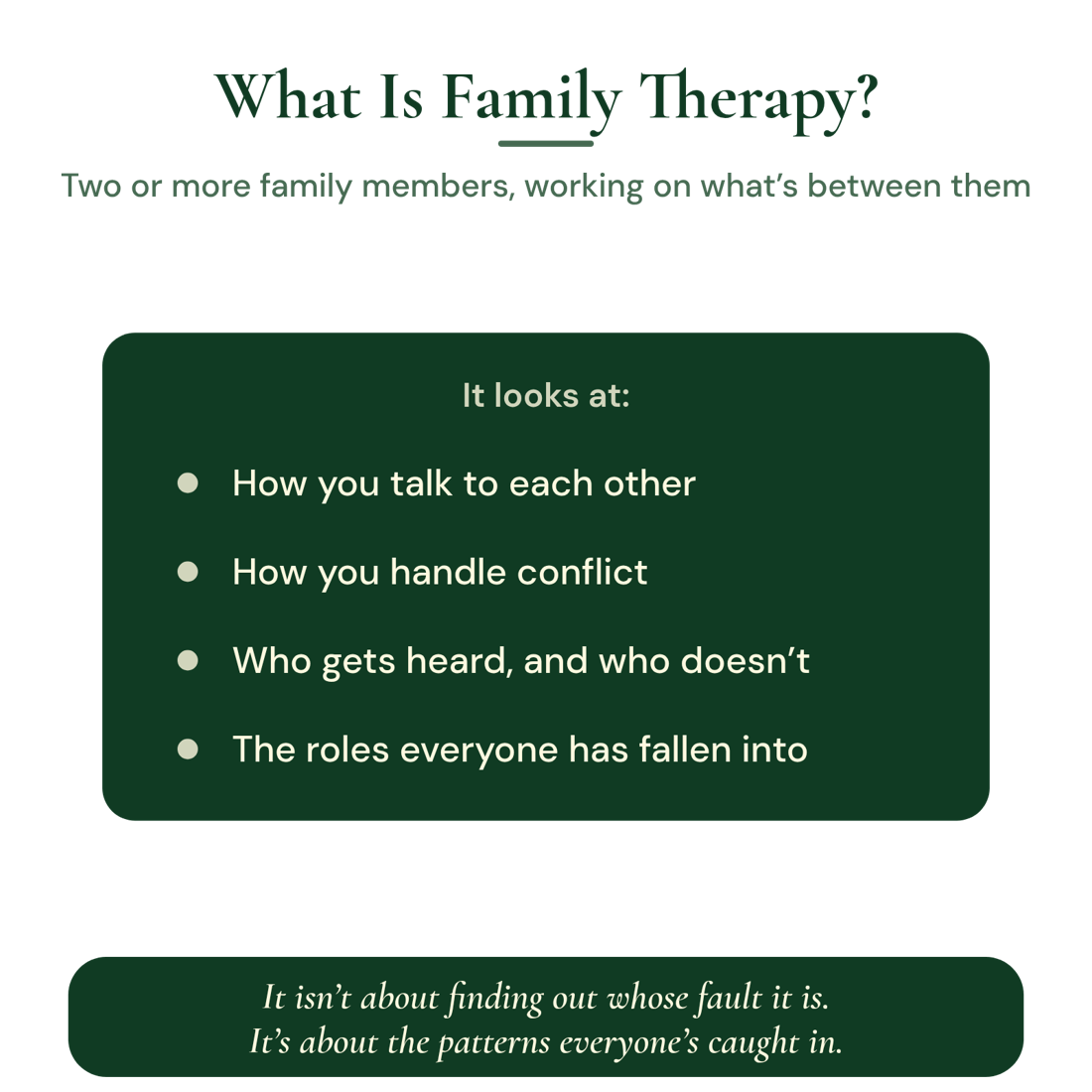
Family therapy is psychotherapy that involves two or more family members working together on the relationships between them. That might mean a parent and teen. Both parents and their kids. Siblings. Adult children and their parents. A blended family figuring out how to become a family. Instead of focusing only on one person, family therapy looks at what happens between people.
How you talk to each other. How you handle conflict. Who gets heard, and who doesn't. What roles everyone has fallen into. What happens when someone is upset. Family therapy isn't about finding out whose fault it is. It's about understanding the patterns everyone's caught in, so you can start responding to each other differently.
Sometimes one person's struggles bring a family to therapy. But the goal isn't to “fix” that person. It's to help the whole family feel more connected, understood, and able to support each other.
What Can Family Struggles Look Like?
Every family has hard moments. But sometimes those moments start to feel like the whole story.
You might notice:
- Frequent arguments or yelling
- The same conflicts happening over and over
- Walking on eggshells at home
- A teen who has shut down or pulled away
- Power struggles over screens, school, chores, or curfew
- Parents disagreeing about rules or discipline
- Siblings constantly fighting
- Someone feeling left out or blamed
- Difficulty talking about feelings
- Avoiding certain topics altogether
- Tension after a separation or divorce
- Struggles adjusting to a blended family
- Conflict with a step-parent or new partner
- A child struggling with anxiety, low mood, school stress, or other concerns
- Parents feeling helpless or burned out
- Grief that nobody knows how to talk about
- Adult siblings who can't agree on how to care for an aging parent
- Old family patterns showing up again and again
- Feeling more like housemates than a family
Sometimes you know exactly what's going on. Other times, you just know home doesn't feel the way you want it to. “I don't know what happened. We used to be close.” We can start there.
Communication & Conflict at Home
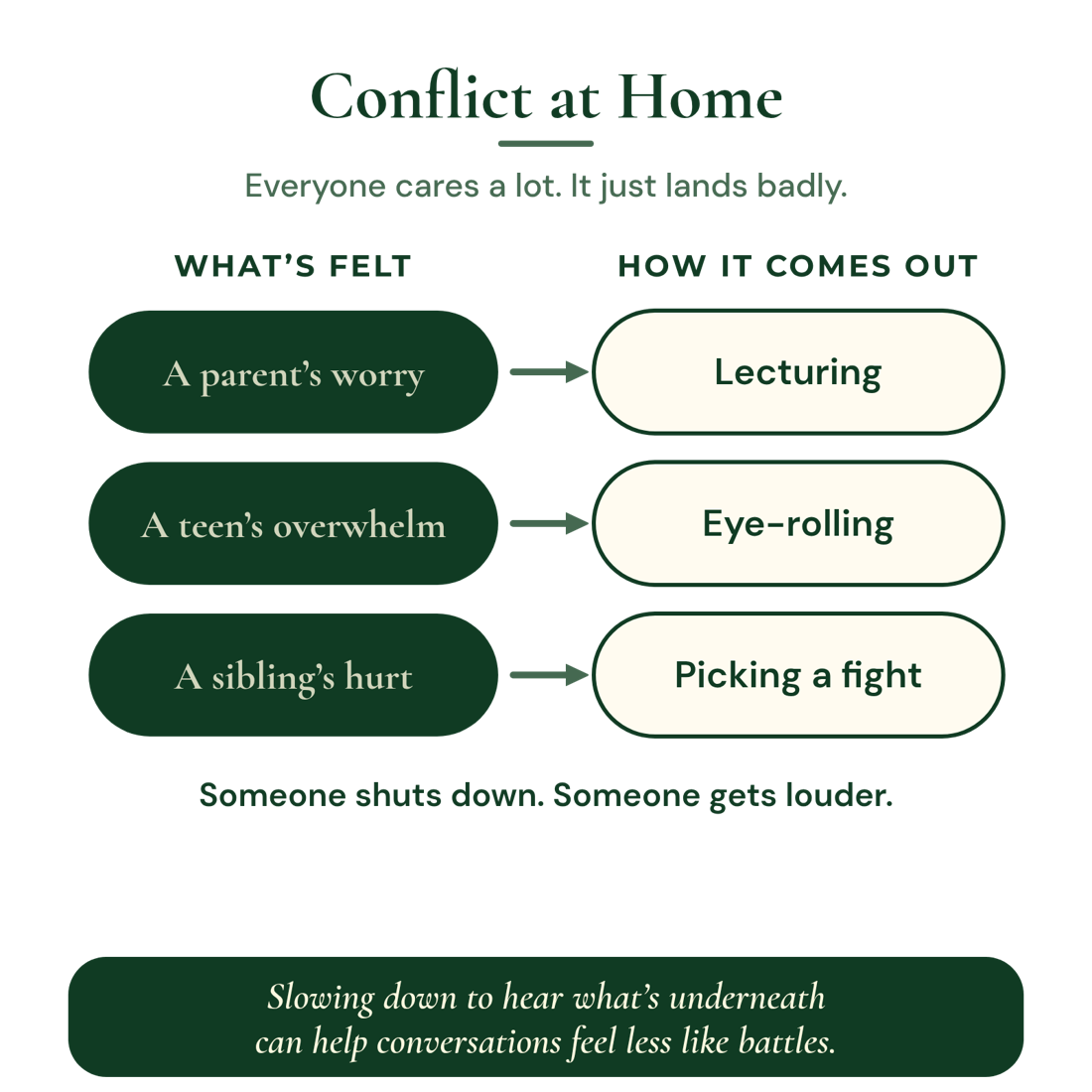
Families don't usually struggle because nobody cares. Usually it's the opposite. Everyone cares a lot. They just express it in ways that land badly. A parent's worry comes out as lecturing. A teen's overwhelm comes out as eye-rolling. A sibling's hurt comes out as picking a fight. Someone shuts down. Someone gets louder. Someone else tries to smooth everything over so nobody gets upset.
And round and round it goes. Family therapy can help slow those moments down. What's actually being said? What's being heard? What's everyone feeling underneath the yelling, the sarcasm, or the silence? When family members start to understand each other's experience, conversations can begin to feel less like battles and more like, well, conversations.
Not sure who to see? We’ll match you.
Tell us a little about what’s going on and we’ll suggest the therapist who fits.
Parent-Teen Tension
The teen years can be hard on everyone. Teens are figuring out who they are, how much independence they want, and how to handle big emotions, friendships, school, social media, identity, and pressure. Parents are trying to keep them safe, guide them, let go a little, and not completely panic in the process. Those two goals can clash.
A lot.
You might be thinking:
“They won't talk to me anymore.” “Everything I say starts a fight.” “I don't know when to step in and when to back off.”
And your teen might be thinking:
“They don't trust me.” “They never actually listen.” “Everything turns into a lecture.” Family therapy can give parents and teens a place to talk with someone neutral in the room. Someone who can help each side hear the other. Translate a little. Lower the temperature. And help you find a middle ground where teens feel respected and parents feel reassured.
Parenting Preteens Through Big Changes
The preteen years can bring a lot of change quickly. Moodiness that seems to appear overnight. New friendships, and friendship drama. More homework and more pressure. Phones, group chats, and social media. Changing bodies. Bigger feelings. Slamming doors where there used to be bedtime stories. Parents may feel like they're suddenly parenting a different kid.
Preteens may feel like nobody understands what's happening to them, including themselves. Family therapy can help families adjust to this stage together, build communication habits that can carry into the teen years, and help everyone feel a little less lost.
Blended Families
Blending a family can be hopeful and exciting. It can also be really hard. You're bringing together different histories, routines, rules, expectations, and loyalties. Kids may be grieving the family they used to have. They might feel caught between parents. They might not want a new step-parent, step-siblings, or a new house.
Step-parents may wonder how much authority they're supposed to have. Parents may feel pulled in every direction. And everyone has different ideas about what Sunday dinner, discipline, or holidays should look like.
You might hear things like:
“You're not my real parent.” “Why do they get to do that and I don't?” “This isn't fair.” Blended families often need time, patience, and a lot of communication to find their footing. Family therapy can help everyone talk about the changes, understand each other's experience, and build something that works for your family.
Not a copy of the old family. A new one.
Separation & Divorce Adjustments
Separation and divorce change a family's whole shape. New homes. New schedules. Two sets of rules. Holidays split in half. Packing a bag every other week. Kids may feel sad, angry, confused, relieved, guilty, or all of those things in the same afternoon. They might act out, withdraw, or try very hard to be “easy” so nobody gets more upset.
Parents may be grieving, co-parenting under stress, and trying to hold everything together. Family therapy can help families talk about the changes honestly, support kids through the adjustment, and reduce the amount of conflict children are exposed to. It can also help parents work on communication around shared parenting decisions, when that's appropriate and safe.
The relationship between the adults may be ending. But the family, in a new form, can still be a place where kids feel loved and secure.
Supporting a Child Through Anxiety or Other Struggles
When one person in a family is struggling, everyone feels it. Maybe your child is dealing with anxiety, low mood, school avoidance, ADHD, OCD, disordered eating, self-esteem concerns, or something you can't quite name. You want to help. But you're not sure how. Should you push them, or give them space? Reassure them, or encourage them to face their fear?
Is this a phase, or something more? And why does everything you try seem to make it worse? Meanwhile, siblings might feel ignored. Parents might disagree about what to do. The whole household can start revolving around one person's struggle without anyone meaning for it to. Family therapy can help parents understand what their child is experiencing and learn ways to respond that are supportive without accidentally keeping the problem going.
It can also give the whole family space to talk about how this has been affecting everyone. Sometimes family sessions work well alongside individual therapy for a preteen or teen. We'll talk with you about what makes the most sense.
Family Grief & Loss
Grief can bring families closer. It can also pull them apart. Everyone grieves differently. One person wants to talk about it constantly. Another can't bear to. One person cries openly. Another gets very busy. One person wants to keep everything the same. Another needs to change everything. Kids and teens may grieve in waves, seeming fine one minute and overwhelmed the next.
Adults may be trying to stay strong for everyone else while barely holding on themselves. Whether you've lost a family member, a grandparent, a pet, a home, a marriage, or a version of family life you expected to have, grief can affect the whole family system. Family therapy can give everyone space to grieve in their own way, understand each other's reactions, and find ways to remember and support each other together.
Adult Family Relationships
Family therapy isn't only for families with kids at home. Sometimes adult family members want help with their relationships too. Adult children and parents trying to relate to each other as adults. Siblings in conflict. Families making decisions about an aging parent's care. Long-standing tension that flares up every holiday.
Old hurts that never really got talked about. Roles that made sense when you were eight but don't fit anymore. Somehow you're a grown adult with a mortgage and a career, and within five minutes of being home for Thanksgiving, you're the bratty younger sibling again. Family therapy can help adult family members talk honestly, understand each other's perspectives, set boundaries, and decide what kind of relationship they want going forward.
How Can Family Therapy Help?
Family therapy can't make everyone agree on everything. Sadly, it also can't make your teen enthusiastic about emptying the dishwasher. But it can help families understand each other better and find new ways forward.
Depending on what your family is working on, therapy may help you:
- Communicate more openly and respectfully
- Reduce yelling and escalation
- Understand recurring conflict patterns
- Repair after arguments
- Improve parent-teen relationships
- Balance independence and safety
- Set clearer and more consistent expectations
- Help parents get on the same page
- Navigate blended-family dynamics
- Support kids through separation or divorce
- Improve co-parenting communication
- Understand and support a child who is struggling
- Reduce family stress and tension
- Make room for each person's perspective
- Process grief together
- Address sibling conflict
- Rebuild trust after a rupture
- Set healthy boundaries
- Navigate adult family relationships
- Make difficult family decisions together
- Feel more connected at home
Sometimes family therapy is about getting through this week without another blow-up. Sometimes it's about understanding patterns that have been passed down for generations. Usually there's room for both.
Ready when you are. Let’s talk.
A free 15-minute consultation is the easiest first step. Book online in a minute, or give us a call.
Our Approach to Family Therapy
Every family is different. Different histories, cultures, values, structures, and ways of showing love. So we don't walk in with a one-size-fits-all plan. Our therapists draw from evidence-informed approaches that may include attachment-based therapy, Emotion-Focused Therapy (EFT), Cognitive Behavioural Therapy (CBT), Dialectical Behaviour Therapy (DBT), solution-focused therapy, and person-centred therapy, depending on your family's needs.
We'll get curious about what's happening between family members, not only within each person. We'll help everyone feel heard, including the people who usually stay quiet. We'll make room for big feelings while also building practical skills for communication, problem-solving, and repair. And we'll tailor sessions to your family, which might mean meeting with everyone, with parents on their own, with a parent and teen together, or with different combinations over time.
Therapy That Feels Human
Family therapy can feel a bit awkward at first. Especially if someone in your family was, let's say, encouraged to attend. That's okay. We want family therapy to feel warm, honest, and genuinely human. Teens can tell us they think this is pointless. Parents can admit they don't know what they're doing. Someone can sit with their arms crossed for the first half of the session.
Someone can cry. Someone can laugh at something that wasn't supposed to be funny. Everyone can disagree. We're not here to judge your family or decide who the problem is. We're here to help everyone feel a little more understood, and to help home feel a little more like home.
Family Therapy in Oakville
Heart of Oak Psychotherapy provides in-person family therapy in Oakville, Ontario for parents and their preteens or teens, as well as adult family members, navigating conflict, communication problems, parent-teen tension, blended families, separation or divorce, family grief, and supporting a family member through anxiety or other struggles.
You don't need to wait until things are falling apart. And you don't need everyone to be on board right away. If something at home isn't working, that's enough of a reason to start.
Online Family Therapy in Ontario & Select Provinces
We also provide online family therapy throughout Ontario and select provinces and territories. Virtual sessions can make it easier to coordinate busy family schedules, school, work, and activities without everyone piling into the car. Online sessions may also be helpful for adult family members who live in different parts of Ontario. Whether you're looking for family therapy in Oakville or online family counselling elsewhere in Ontario, we'll help you find a therapist whose experience, personality, approach, and availability fit what your family is looking for.
Your therapist
Therapists who work with family therapy
Book a free 15-minute consultation with any of us, or let us suggest who fits. Meet the whole team →


Katarina
Registered Psychotherapist (Qualifying)
Sees: Teens, adults, families, and first responders & healthcare workers
Cost & insurance
What sessions cost
Couples or family therapy
- 50-minute session$200
- 75-minute session$300
- Receipts are provided for extended health benefits. Many plans that cover a Registered Psychotherapist (Qualifying) will reimburse sessions. Please check your plan to confirm your coverage.
- We don’t direct bill insurance or work with EAPs.
Questions
Frequently Asked Questions About Family Therapy
Can’t find your answer? Call (289) 201-1951 or email hello@heartofoakpsychotherapy.com.
Does everyone in the family need to attend?
Not necessarily. Family therapy can look different depending on your family and your goals. Sometimes it makes sense for everyone to attend. Other times, sessions might involve a parent and teen, parents on their own, siblings, or different combinations of family members over time. If someone isn't ready to participate, therapy can still begin with the people who are.
Your therapist will talk with you about who to include and when.
How does confidentiality work with teens in family therapy?
Confidentiality is something your therapist will explain clearly at the beginning, so everyone knows what to expect. Teens often worry that anything they say will be shared with their parents. Parents often worry they'll be kept completely in the dark. Your therapist will talk with your family about what stays private, what may be shared in family sessions, and how information is handled if a teen also has individual sessions.
Therapy is confidential, with legal and professional limits. If there are concerns about someone's safety, information may need to be shared. The goal is to help teens feel safe enough to be honest while keeping parents appropriately involved.
What if my teen refuses to come?
That's pretty common. Sometimes teens feel like family therapy means they're the problem. It can help to frame therapy as something the whole family is doing together, not something being done to them. If your teen isn't ready, parents can still start on their own. Parent sessions can help you understand what's happening and try new ways of responding at home.
Is family therapy only for families in crisis?
No. Some families come to therapy during a crisis. Others come because they've noticed patterns they want to change before they get worse, or they're heading into a big transition like a separation, move, or blended household. You don't need to wait until things feel unmanageable.
What's the difference between family therapy and individual therapy for my child?
Individual therapy focuses on your child's own experiences, thoughts, feelings, and goals, with a therapist they meet with on their own. Family therapy focuses on relationships and patterns between family members. Sometimes one is a better fit than the other. Sometimes both can be helpful at the same time. We can help you figure out where to start.
Can adult family members come to family therapy?
Yes. Family therapy can include adult children and parents, adult siblings, or other family members who want to work on their relationships, communicate through a difficult decision, or address long-standing conflict.
Will the therapist take sides?
No. Your therapist's role is to help everyone feel heard and to support the relationships in the family, not to decide who's right. That might mean gently challenging everyone at different times. Parents included.
Free 15-minute matching call
Not sure who to see? We’ll match you.
Finding the right fit matters more than finding the perfect words. Answer two quick questions and book a free consultation; we’ll point you to the therapist who suits what you’re looking for.
Quick guide to our team
Who works with what, at a glance.
| Couples | Michaela, Megan |
| Preteens | Mairin, Michaela |
| Teens | Mairin, Michaela, Megan (16+), Katarina |
| Families & parenting | Michaela, Megan, Katarina |
| OCD & intrusive thoughts | Mairin, Megan (ERP: Mairin) |
| Eating disorders & body image | Megan, Katarina |
| Trauma & PTSD | Mairin, Megan, Katarina |
| ADHD & neurodivergence | Mairin, Michaela, Megan |
| Men’s mental health | Mairin (a particular focus), Michaela, Megan, Katarina |
| First responders & healthcare workers | Mairin, Megan, Katarina |
| Anxiety, stress & self-esteem | All four of us |
Not on the list? Ask us in your free consultation.
Your Family Doesn't Have to Be Perfect to Feel Close
Every family argues. Every family has misunderstandings, hurt feelings, and hard seasons. That doesn't mean your family is broken. It means you're a group of real people trying to share a life, a home, and a whole lot of feelings. Imagine dinner without a standoff. A disagreement that doesn't turn into a blow-up. A teen who rolls their eyes but still tells you what's going on.
Talking about the hard thing without someone leaving the room. Feeling like you're on the same team again. You don't need to have it all figured out. You just need to be willing to try something different together.
Not sure which therapist is right for you?
Getting everyone to agree on a therapist could be a family therapy session in itself. We'll make it easier. Submit our Intake Form or book a free 15-minute matching call with Katarina Jurriaans. She'll learn a little about what's happening in your family, what you're hoping will change, and what kind of therapist you think everyone would connect with, then help match you based on areas of focus, approach, personality, and availability.
Book your free consultation. Home can feel like a softer place to land again.
Other ways we can help
Something else on your mind? We can help with that too.
Many people come in for one thing and find it’s connected to another. Explore the other areas our therapists work with.
Not sure it fits a box?
Most people aren’t. Book a free 15-minute consultation and we’ll help you sort out where to start.
Book a free 15-minute matching call →Virtual therapySecure video sessions in Ontario & select provinces›AnxietyWorry, panic, racing thoughts›DepressionLow mood, numbness, no energy›Trauma & PTSDAfter one hard event, or years of them›Preteens & teensSchool, friendships, big feelings›Grief, loss & pet lossIncluding the loss of a pet›Eating disorders & body imageFood, body and self-worth›OCDIntrusive thoughts, doubt, compulsions›ADHDFocus, overwhelm, follow-through›Men's therapyStress, anger, pressure to cope alone›Stress & life transitionsBurnout, change, new chapters›Relationships & datingPatterns, dating, attachment›LGBTQIA+ affirming careBe fully yourself in the room›Couples therapyConflict, distance, reconnecting›First responders & healthcare workersShift work, hard calls, carrying it home›Self-esteem & confidenceThe inner critic, people-pleasing, comparison›Not sure? We’ll match youTell us what’s going on›