
Mairin
Registered Psychotherapist (Qualifying)
Sees: Preteens, teens, adults, and first responders & healthcare workers

There isn't a right way to grieve





Tell us a little about what’s going on and we’ll suggest the therapist who fits.
We’ll match you →Some days you're okay. And then a song comes on. You find something of theirs in a drawer. You automatically reach for your phone to text them. You walk through the door expecting your pet to be there. Someone casually asks how you're doing. And suddenly, you're right back in it. Grief can be strange like that. It doesn't move neatly from one stage to the next. It doesn't care that other people think enough time has passed. And it definitely doesn't follow a schedule. Maybe you're devastated. Maybe you're angry. Maybe you're numb. Maybe you're relieved—and then feel guilty for being relieved.
Maybe you're functioning surprisingly well and wondering whether you're grieving “properly.” Or maybe everyone around you seems to have moved on while your world still feels completely different. We provide grief, bereavement, loss, and pet loss therapy in Oakville and online across Ontario and select provinces and territories for preteens, teens, and adults navigating death, illness, relationship loss, pregnancy loss, pet loss, major life changes, and the many other forms grief can take.
You don't have to make your grief easier for other people to understand here.
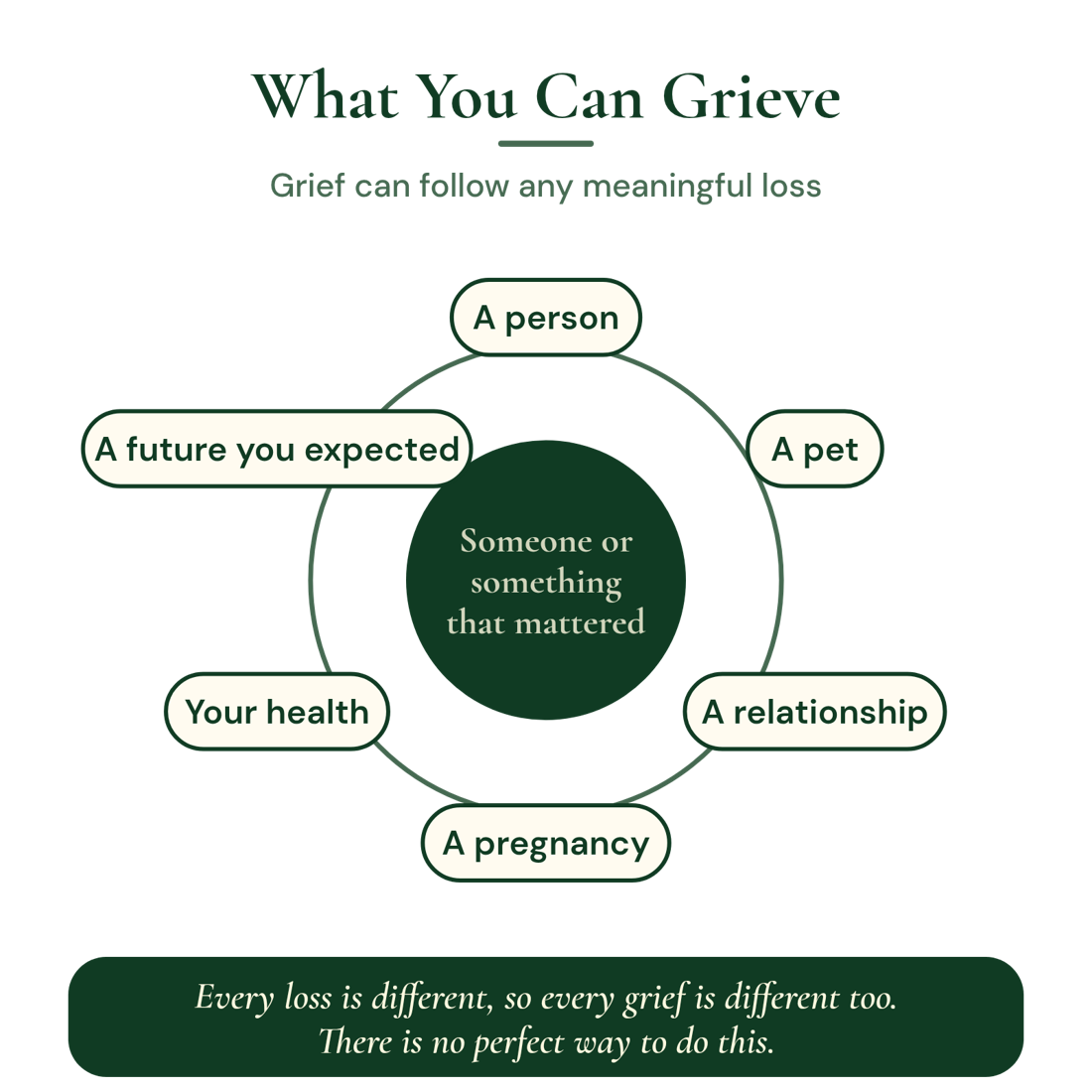
Grief is a natural response to losing someone or something that mattered to you. We often associate grief with death, but grief can happen whenever we experience a meaningful loss or major change. You can grieve a person. A pet. A relationship. A pregnancy. Your health. A friendship. A home. A career. A version of your family. A future you expected to have. Or even a version of yourself that no longer exists.
Grief can affect your emotions, thoughts, body, relationships, identity, sleep, appetite, concentration, and ability to function day to day. And because every relationship and every loss is different, every experience of grief is different too. There is no perfect way to do this.
Grief can involve sadness, but it can also involve emotions that people don't always expect.
You may experience:
Sometimes grief comes in waves. Sometimes it's a constant ache. And sometimes you feel completely normal for several hours before it hits you all over again. None of that means you're doing grief wrong.
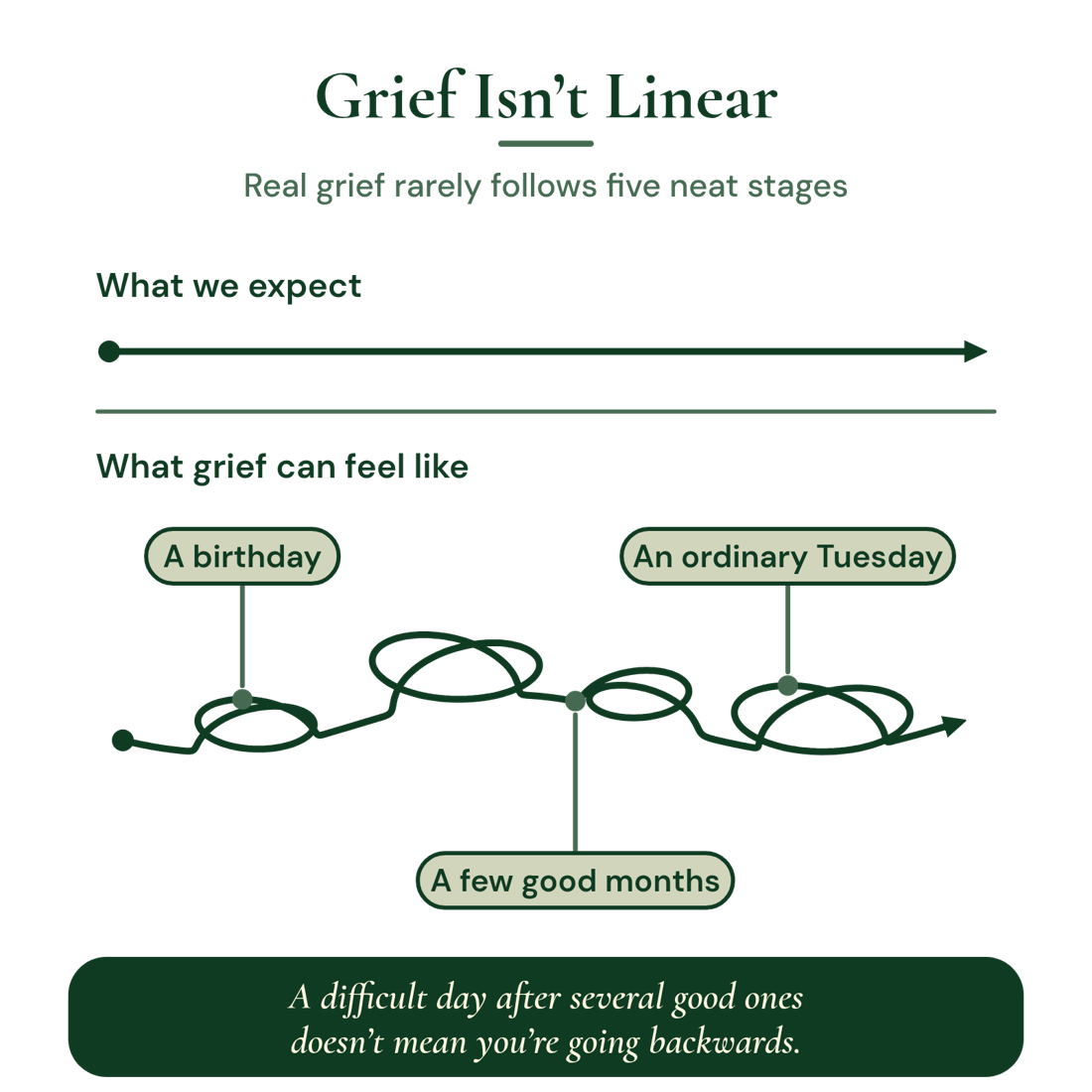
You may have heard about the “stages of grief.” Denial. Anger. Bargaining. Depression. Acceptance. Those ideas can be useful for describing experiences that sometimes occur during grief—but real grief rarely unfolds in a neat five-step sequence. You might feel accepting one day and furious the next. You might laugh at dinner and cry in the car on the way home. You may feel better for several months and then struggle intensely around a birthday, anniversary, holiday, familiar place, or completely ordinary Tuesday.
Healing doesn't mean progressing perfectly from sadness to acceptance. And having a difficult day after several good ones doesn't mean you're going backwards. Grief isn't a straight line.
Tell us a little about what’s going on and we’ll suggest the therapist who fits.
Loss can take many forms, and some types of grief receive far more recognition and support than others.
Losing a parent, partner, child, sibling, family member, friend, or another important person can fundamentally change the shape of your life. You're not only grieving the person. You may also be grieving routines, traditions, roles, conversations, plans, inside jokes, a sense of safety, or the future you expected to share.
Sometimes you're grieving who you were when that person was still here.
Grief doesn't always begin after a death. When someone you love has a terminal illness, progressive condition, or declining health, you may begin grieving while they're still alive. You may feel sadness, fear, anger, helplessness, guilt, hope, exhaustion, and even relief at different points. It can feel strange to grieve someone who is still here.
But anticipating a loss can carry its own kind of pain.
An unexpected death can leave you trying to process both the loss itself and the way it happened. Accidents, suicide loss, violence, sudden illness, or other traumatic circumstances can sometimes involve shock, intrusive memories, unanswered questions, anger, guilt, or difficulty accepting that the person is really gone.
Grief and trauma can overlap, and therapy can make space for both.
Miscarriage, stillbirth, pregnancy loss, infertility, unsuccessful fertility treatment, and reproductive challenges can involve profound grief. Sometimes people around you don't fully understand the magnitude of what was lost. You may be grieving not only a pregnancy, but the future you had already started imagining. Pregnancy announcements, baby showers, due dates, holidays, and questions from other people can become painful reminders.
Your grief deserves to be taken seriously.
A person doesn't have to die for you to grieve them. Breakups and divorce can involve grieving your partner, your routines, your home, mutual friendships, your sense of identity, and the future you thought you were building together. And sometimes the person you're grieving is still very much alive. That can make the loss particularly confusing.
Friendship breakups, family estrangement, and relationships that slowly disappear can be deeply painful. But because we don't always treat these losses with the same seriousness as death or romantic breakups, you may feel like you're expected to simply move on. You can miss someone and still know the relationship couldn't continue.
Both things can be true.
A diagnosis, disability, chronic illness, injury, infertility, job loss, retirement, moving, becoming a caregiver, or another major life transition can involve grief too. Sometimes you're grieving the life you used to have. Sometimes you're grieving the future you thought you'd have. And sometimes you're grieving a version of yourself.
For many people, losing a pet means losing a member of the family. They weren't “just a dog.” Or “just a cat.” They were there when you woke up. They followed you around the house. They knew your routines. They sat beside you when you were having a terrible day. They were part of your holidays, your walks, your photos, your home, and thousands of tiny everyday moments you didn't realize you'd miss so much. And then suddenly the house feels too quiet.
Pet loss can be especially painful because the world doesn't always recognize it in the same way it recognizes human loss. You might receive sympathy for a few days and then feel like you're expected to move on. But your attachment was real. So your grief is real too.
Making the decision to euthanize a beloved pet can bring an additional layer of grief. Even when you know intellectually that you made the most compassionate decision you could, emotionally you may replay it over and over. “Was it too soon?” “Did I wait too long?” “Were they scared?” “Could I have done something else?” “Did they know how much I loved them?”
Guilt is incredibly common after euthanasia. Therapy can give you somewhere to talk honestly about those questions, the decision you had to make, the final moments, and the relationship you shared with your pet. We won't minimize it. And we won't tell you it was “just an animal.”
Not every relationship we lose was simple. You can deeply love someone and also have been hurt by them. You can miss someone and be angry with them. You can grieve a parent who wasn't the parent you needed. You can feel devastated that someone died and relieved that their suffering—or yours—has ended. You can grieve an abusive relationship. You can miss someone you know wasn't good for you. You can feel relief after years of caregiving and then feel horrible for experiencing that relief. Human relationships are complicated. Grief can be complicated too.
You don't have to turn the person or relationship into something it wasn't in order to grieve it. Therapy can make room for all of it.
Grief itself is not a mental illness. There is also no universal deadline by which you should be “over” a significant loss. Over time, grief often changes. The loss may remain important, but many people gradually find themselves able to reconnect with relationships, responsibilities, meaning, and life alongside it. For some people, however, grief remains extremely intense and disabling for an extended period.
You may feel unable to re-engage with life, experience persistent intense longing or preoccupation with the person who died, struggle to accept the death, feel that life has lost its meaning, or experience significant impairment in everyday functioning. Grief can also occur alongside depression, anxiety, trauma symptoms, substance use, or suicidal thoughts.
If you're struggling, you don't need to decide whether your grief is “normal enough” or “serious enough” before reaching out. We can start with what you're experiencing.

Therapy can't change what happened. And we're not going to try to make you forget someone you loved. Grief therapy isn't about getting you to “move on.” It's about giving you somewhere to carry what happened differently.
Depending on what you're experiencing, grief therapy may help you:
Sometimes therapy is about developing coping strategies. Sometimes it's about making sense of what happened.
And sometimes you just need somewhere you can say:
“I really, really miss them.” Without someone trying to fix it.
One of the things people sometimes fear about healing is that feeling better means forgetting. If you stop crying every day, does that mean they mattered less? If you laugh again, are you moving on too quickly? If you eventually love another pet, does that replace the one you lost? If you build a new life, are you leaving the old one behind?
Healing doesn't require erasing your connection to what you've lost. For many people, grief becomes less about “moving on” and more about learning how to move forward while carrying the relationship, memories, and meaning with you. There can eventually be room for both. Missing what was. And living what comes next.
There isn't one correct way to grieve, so there isn't one correct way to do grief therapy. Your therapy may involve exploring memories, relationships, identity, emotions, guilt, trauma, meaning, or the ways your life has changed since the loss. We may also work on practical strategies for getting through particularly difficult days.
But we won't rush you toward acceptance because someone else thinks you should be there already. Your grief gets to have its own timeline.
A free 15-minute consultation is the easiest first step. Book online in a minute, or give us a call.
Grief can make other people uncomfortable. Sometimes they don't know what to say. So they try to make it better. Everything happens for a reason. They're in a better place. At least you had them for as long as you did. You can always get another dog. Even when people mean well, those words can land terribly. You don't need to make your grief more comfortable for us.
You can cry. You can be angry. You can laugh while telling us a story about them. You can say something you feel guilty for thinking. You can bring photos. You can tell us the same story more than once. You can spend an entire session talking about your dog. You can say you don't want advice—you just want someone to understand how much this hurts.
Therapy can be a place where your grief doesn't need to be fixed, rushed, minimized, or explained away.
We provide in-person grief counselling, bereavement therapy, and pet loss therapy in Oakville, Ontario for preteens, teens, and adults. Our therapists support clients experiencing many forms of grief and loss, including death of a loved one, pet loss, anticipatory grief, relationship loss, pregnancy loss, family estrangement, traumatic loss, chronic illness, major life transitions, and more.
Whether your loss happened last month or years ago, you don't need to wait until grief becomes unbearable before reaching out.
We also provide online grief counselling and pet loss therapy throughout Ontario and select provinces and territories. For some people, virtual therapy feels particularly comforting during grief. You can talk from your own home. You can have your pet beside you. You can keep the box of tissues nearby. And you don't have to immediately pull yourself together and drive home when the session ends.
Whether you're looking for grief therapy in Oakville or online grief support elsewhere in Ontario, we'll help you find a therapist whose experience, approach, personality, and availability fit what you're looking for.
Book a free 15-minute consultation with any of us, or let us suggest who fits. Meet the whole team →
Individual therapy
Can’t find your answer? Call (289) 201-1951 or email hello@heartofoakpsychotherapy.com.
There isn't a particular level of grief you need to reach before you're allowed to seek support. You may want therapy because you're struggling to function, because your grief feels overwhelming, because complicated feelings are coming up, or simply because you want somewhere you can talk freely about your loss. All of those are valid reasons.
There isn't a universal timeline. The intensity of grief often changes over time, but significant losses can remain meaningful throughout our lives. Anniversaries, milestones, holidays, changes in your own life, or unexpected reminders can bring grief back to the surface even years later. The goal of therapy isn't to put you on a timeline.
Absolutely. The relationship people have with their animals can be incredibly significant, and losing a pet can cause profound grief. You don't need to minimize that relationship because someone else doesn't understand it. Pet loss is welcome here.
Yes. Guilt and second-guessing can be common after making end-of-life decisions for a pet. Therapy can give you space to process the circumstances surrounding the decision, the responsibility you carried, your final memories, and the relationship you shared with your pet.
Relief can sometimes be part of grief, particularly after a long illness, caregiving period, difficult relationship, or prolonged period of suffering. Feeling relief doesn't automatically mean you didn't love the person. Grief can hold emotions that seem contradictory.
You are still allowed to grieve. Loss doesn't erase complicated relationships. You can miss someone, love them, resent them, feel angry with them, and grieve what you never received from them—all at the same time. Therapy can be especially helpful when grief doesn't fit the simple story other people expect.
There is no expiry date on grief. Sometimes a loss resurfaces because of an anniversary, milestone, another death, becoming a parent yourself, entering a new relationship, or simply reaching a point where you're finally ready to process what happened. You can come to therapy whenever you're ready.
Finding the right fit matters more than finding the perfect words. Answer two quick questions and book a free consultation; we’ll point you to the therapist who suits what you’re looking for.
Who works with what, at a glance.
| Couples | Michaela, Megan |
| Preteens | Mairin, Michaela |
| Teens | Mairin, Michaela, Megan (16+), Katarina |
| Families & parenting | Michaela, Megan, Katarina |
| OCD & intrusive thoughts | Mairin, Megan (ERP: Mairin) |
| Eating disorders & body image | Megan, Katarina |
| Trauma & PTSD | Mairin, Megan, Katarina |
| ADHD & neurodivergence | Mairin, Michaela, Megan |
| Men’s mental health | Mairin (a particular focus), Michaela, Megan, Katarina |
| First responders & healthcare workers | Mairin, Megan, Katarina |
| Anxiety, stress & self-esteem | All four of us |
Not on the list? Ask us in your free consultation.
There may come a day when remembering them makes you smile before it makes you cry. When you can walk past that place without completely falling apart. When the silence in the house doesn't feel quite as unbearable. When you can imagine something good happening in your future and actually want to be there for it. That doesn't mean you've forgotten.
It doesn't mean the relationship mattered less. And it doesn't mean you're “over it.” It means you're learning how to carry something you never wanted to have to carry. You don't have to do that alone. We offer grief counselling, bereavement therapy, and pet loss therapy in Oakville and online throughout Ontario and select provinces and territories for preteens, teens, and adults.
Not sure which therapist is right for you?
That's okay. You don't need to read every therapist bio while you're already trying to navigate a loss. Submit our Intake Form or book a free 15-minute matching call with Katarina Jurriaans. She'll learn a little about what you're going through and what you're looking for in a therapist, then help match you based on areas of focus, approach, personality, and availability.
Book your free consultation. There's room for your grief here.
Many people come in for one thing and find it’s connected to another. Explore the other areas our therapists work with.
Most people aren’t. Book a free 15-minute consultation and we’ll help you sort out where to start.
Book a free 15-minute matching call →